Sunday, September 22, 2013

Climate, Keystone and the problem of fossil fuel demand

American political conservatives like to say that their strategy of tax cuts all the time is designed to "starve the beast." The "beast," of course, refers to government, and "starving" it means reducing its revenues through tax cuts in order to spur corresponding cuts in spending. They liken their strategy to reining in a profligate child by reducing his or her allowance.

Whatever one believes about the efficacy of this strategy, it is now being employed in surprising ways in a new field by unexpected people. The brilliant symbolism of opposing the Keystone XL pipeline is intended to highlight the need to address the causes of climate change by reducing our use of carbon-based fuels. The reasoning in this case is that stopping the pipeline would prevent the increased exploitation of what opponents call the "carbon bomb" of the Alberta tar sands. Stopping the Keystone XL would supposedly prevent the companies controlling the tar sands from having access to oil markets. In effect, activists are trying to starve the fossil-fuel-consuming beast that is the global economy.

If this is the goal, then this strategy must be labeled an instant failure. The tar sands oil companies are already exploring alternate routes for shipping synthetic crude derived from tar sands via other proposed pipelines. One such pipeline, Energy East, would move oil from western Canada to eastern Canada, finally ending the bizarre situation in which Canada, one of the world's largest oil exporters, must import close to 40 percent of its oil needs. The country currently lacks sufficient pipeline capacity to bring oil from western Canada where it's found to eastern Canada where it's mostly consumed.

These developments take nothing away from what has been a very successful strategy by climate change activists to rally people behind fighting against something concrete as a way of advancing political awareness and action on climate policy. But this does point up a problem with attempts to reduce fossil fuel consumption by organizing people to oppose specific distribution projects.

Attempts in my own newly adopted home of Oregon to stop the construction of coal export terminals are understandable given the foreseeable problems of such terminals. The transport of coal through the area is not without environmental consequences. And, having visited friends who live near train tracks on the upper Mississippi River, a key conduit for coal trains, it is no picnic to have scores of such trains passing through town each week. They back up traffic and shake nearby homes at their very foundations each time they pass.

But once again, if these coal export terminals aren't built, coal producers will find other ways to transport their coal to market.

The only case in which production might be reined in by such tactics is natural gas. Natural gas cannot be easily transported by means other than pipeline. It cannot, for instance, be loaded on trucks or trains economically. To send natural gas overseas by ship, it must first be turned into liquid form and then transferred to pressurized tanks on specially outfitted carriers.

Activists in the United States who have opposed these liquefied natural gas export facilities are losing the battle as the federal government continues to approve new facilities, believing (wrongly) that U.S. production of natural gas is in a long-term upswing.

Just as the "starve the beast" strategy has failed to bring down government spending--politicians have found out that they actually have to vote for cuts in specific programs to do that--so, too, the strategy to reduce production of fossil fuels by stopping the construction of specific distribution facilities is bound to fail.

If reducing consumption of fossil fuels is the goal, what we actually need to do is strike at demand. The simplest and most effective way to do this is to levy high and rising taxes on fossil-fuel-based energy. The Europeans have done this for a long time, and their per capita energy consumption is half that of Americans.

Those who advocate market-based approaches to constructing our energy future ought to be clamoring for a high and rising carbon tax. Such a tax doesn't tell industry or individuals specifically how to move from carbon-based fuels to something else. It just tells them that they need to. As such, it would be one of the most effective measures we could take to spur innovation in energy efficiency and renewable energy production.

(Beyond this are more direct measures such as applying passive house standards to new construction and retrofits for both residential and commercial buildings, standards that reduce heating and cooling energy use by 80 to 90 percent. High fees or taxes for driving a personal automobile and appropriate infrastructure changes would incentivize people to shift to car pooling, car sharing, bicycling and mass transit. Even appeals for civic responsibility designed to make it "cool" to be energy efficient need to be deployed.)

Stopping dirty coal export facilities or tar sands pipelines is actually a much easier sell than getting people to embrace voluntarily much higher energy prices (even if the rise occurs gradually as energy taxes are increased incrementally each year). And yet, such a strategy would go far in eliminating the incentive to build the very facilities which protesters are currently trying to stop.

Logic is on the side of higher energy taxes. But can logic prevail when we are so fearful as a society of a future without fossil fuels that we won't implement the one simple measure that would speed the inevitable energy transition--and thereby avert a climate change or energy supply catastrophe that would force our hand anyway?

Kurt Cobb is an author, speaker, and columnist focusing on energy and the environment. He is a regular contributor to the Energy Voices section of The Christian Science Monitor and author of the peak-oil-themed novel Prelude. In addition, he has written columns for the Paris-based science news site Scitizen, and his work has been featured on Energy Bulletin (now Resilience.org), The Oil Drum, OilPrice.com, Econ Matters, Peak Oil Review, 321energy, Common Dreams, Le Monde Diplomatique and many other sites. He maintains a blog called Resource Insights and can be contacted at kurtcobb2001@yahoo.com.

Sunday, September 15, 2013

Albert Bartlett: On message about exponential growth to the end

Albert Bartlett might have been another obscure physics professor had he not put together a now famous lecture entitled "Arithmetic, Population and Energy" in 1969. The lecture, available broadly on the internet, begins with the line: "The greatest shortcoming of the human race is our inability to understand the exponential function."

The logic is surprisingly simple and irrefutable. Exponential growth, which is simply consistent growth at some percentage rate each year (or other time period), cannot proceed indefinitely within a finite system, for example, planet Earth. The fact that human populations continue to grow or that the extraction of energy and other natural resources continues to climb does not in any way refute this statement. It simply means that the absolute limits have not yet been reached.

Bartlett, who died this month at age 90, gave his lecture all over the world 1,742 times or on average once every 8.5 days for 36 years to audiences ranging from junior high students to seasoned professionals in many fields. His ability to stay on message for so long about something so important should make him the envy of every modern communications professional.

His favorite shortcut is the doubling time, the time it takes to get to twice the original number at a constant rate of growth. The formula is 70 divided by the percentage rate of growth per year (or other period). Just a 2 percent growth rate doubles the rate of use of a resource or the size of world population in 35 years. Actual world population growth is about 1.2 percent per year today, which seems benign; but, it implies the next doubling within 58 years to 14 billion. (U.N. forecasts project world population will reach 10 billion by 2070--57 years from now--and continue to grow through 2100.)

In his lecture Bartlett relates that in his hometown of Boulder, Colorado, city council members once stated publicly their preferences for population growth rates ranging from 1 percent to 5 percent per year. In the course of 70 years, roughly one lifetime, the 5 percent rate would make Boulder's population (about 100,000) some 32 times larger or about 3.2 million, which would make it the third largest city in the country behind Los Angeles and in front of Chicago. A city that size could not possibly fit in the valley now home to Boulder, Bartlett explains. Attempting to do so would inevitably eliminate all open space, something highly prized by Boulder residents.

Has Bartlett made a dent in our habitual ways of thinking about growth? Maybe. There were others back when Bartlett started giving his lecture who asked the same questions in a different form. One manifestation of that questioning was the groundbreaking study The Limits to Growth which, despite what its detractors have said, made no predictions. Rather the study models resource use over time given a large range of conditions including an endowment of resources that was twice what anyone imaged they might be at the time. The troubling conclusion of the study was that nearly all scenarios led to the crash of industrial civilization at some point.

The key observation in that study aligns with Bartlett's, namely that exponential growth in the consumption of finite resources is unsustainable. At some point growth in the rate of extraction will cease. And, given the dependence of the economy on continuous growth of resource inputs including energy, this leads to instability and finally decline.

Let me help you envision what exponential growth means. If you receive 10 percent interest on $100, after one year, your $100 will turn into $110. In the second year, at the same interest rate, your money will turn into $121. At the end of year 50, the amount will be $11,739, a considerable sum. At the end of year 100, the amount will be $1,378,061. By year 200 your heirs will have almost $19 billion.

If we dial down the rate to, say, just 2 percent, the corresponding figures are $269 for year 50, $724 for year 100 and $5,248 for year 200. Clearly, rate matters a lot! But, even so, if these numbers represented the rise in the rate of resource consumption, even at two percent after 50 years, we'd be consuming resources at 2.7 times the original rate. At 100 years it would be 7.2 times, and at 200 years, 52 times.

Now money is a social invention which can be created by electronic keystrokes these days in any amount. Eons of geologic transformation and concentration are not required. But finite natural resources by definition have a limit. We cannot say with precision what that limit is, but we know it is there.

The rejoinder to Bartlett and others like him is that technology will overcome any limits, and that we'll use substitutes for resources that run low. It's hard to imagine what might be a good substitute for uncontaminated, potable water; but, in the cornucopian's mind anything is possible. It's also hard to imagine a modern technical society without metals. But, we'll think of something, right? However, please don't say that that something is made out of materials derived from oil, natural gas or coal which are also finite.

The problems posed by exponential growth mean we'll have to think of "something" at increasingly short intervals given the ever rising rates of consumption and the broad range of finite materials we depend on--especially fossil fuels (oil, natural gas, coal) and much of the periodic table of elements including the usual suspects such as iron, copper, aluminum, zinc, silver, platinum, and uranium and the more exotic ones such as lithium, titanium, the so-called rare earth elements, and helium.

It's not just one substitute we'll have to find. And, we may be faced with having to find many all at once. The idea that technological innovation will always and everywhere stay ahead of an ever increasing rate of depletion may be true or not true. But we cannot know this ahead of time.

In fact, if it were true, why hasn't technological innovation brought oil prices down to where they were in the 1990s before the run-up of the last decade? There's no commodity more central to the functioning of our economy; and, there's been huge spending by the oil industry and deployment of revolutionary new techniques. Yet, the price remains stubbornly high. The glut that was promised year after year has failed to materialize. The problem is not that technological innovation has ceased; it's that it may not be enough.

And so, we are assuming huge risks by taking it on faith that all hurdles to the continuance of our technical civilization as it stands can be overcome in time and forever by technological advances. We are taking it on faith, essentially, that we will never screw up so badly that our highly-efficient, just-in-time economy will cease to grow and finally decline until it reaches a level that can be sustained by a much simpler and less technically advanced set of practices, probably for a much smaller population.

It stands to reason that even the RATE of technological advancement must have a limit. Humans are not infinite in their powers of reason. Even with computers, we cannot innovate at infinite speeds.

It is the rate issue that Albert Bartlett spent the last half of his life trying to bring to the fore in the minds of the public and policymakers. While many in the scientific community have now come to understand his message, the broader public and policymakers still seem largely in the dark. Rates, and particularly exponential growth, are clearly not easy to grasp; otherwise, so many more human beings would have grasped these concepts.

But we have Albert Bartlett to thank for relentlessly reminding us that we should pay attention to the simple math that refutes our notions of endless growth. He asks in his lecture the following question:

Can you think of any problem on any scale, from microscopic to global, whose long-term solution is in any demonstrable way aided, assisted or advanced by having larger populations at the local level, the state level, the national level, or globally?

So far, I can't think of any.


Kurt Cobb is an author, speaker, and columnist focusing on energy and the environment. He is a regular contributor to the Energy Voices section of The Christian Science Monitor and author of the peak-oil-themed novel Prelude. In addition, he has written columns for the Paris-based science news site Scitizen, and his work has been featured on Energy Bulletin (now Resilience.org), The Oil Drum, OilPrice.com, Econ Matters, Peak Oil Review, 321energy, Common Dreams, Le Monde Diplomatique and many other sites. He maintains a blog called Resource Insights and can be contacted at kurtcobb2001@yahoo.com.

Sunday, September 08, 2013

Our energy future: "They'll think of something"

With oil prices hovering near historic highs and coal, natural gas and uranium prices yo-yoing during the last several years, concerns about the future of fossil fuel and uranium supplies often elicit the response: "They'll think of something. They always do."

This kind of thinking is usually premised on the idea that the future will look like the past, only bigger and better. It does not even admit the possibility that we may need to reduce our energy use. We'll come back this issue later.

The pronoun "they" in the generic quote above is vague, and the speaker does not know that he or she is actually referring to two distinct technological approaches to our energy future. Each technology progresses amid a different and highly consequential backdrop.

Let me cut to the chase. Advancements in technology designed to extract more oil, natural gas, coal and uranium from the ground are in a race with geological constraints. The more of each type of fuel we extract, the more difficult it is to wrest each subsequent barrel, cubic foot, or ton from the Earth's crust. The deposits become leaner, that is, there are fewer units of what we want per ton of earth--and more refractory, that is, more challenging to process in order to separate the stuff we want from the stuff that isn't oil, natural gas, coal and uranium. The empirically established principle is that we go after the easy deposits first and save the difficult ones for later.

So now, we are arriving at the difficult ones: shale gas, tight oil, tar sands and low-grade uranium deposits. Rather than debate the future supplies of each which cannot be known with any certainty, let me turn to the backdrop for what we call renewable energy.

The technological progress we make in solar and wind occur against a dramatically different backdrop. The light from the sun is not becoming less and less intense over the long run forcing researchers to think of ways to capture more and more of the diminishing intensity of sunlight. Instead, even though there are cycles to the sun and cloudy days, the light from the Sun that hits the Earth is remarkably steady. In fact, over the next 5 billion years, the Sun will actually increase in brightness before starting its transformation into a red giant.

Unlike researchers who experiment with methods for extracting ever more lean and refractory deposits of fossil fuels and uranium, solar energy researchers are not fighting a depleting Sun in any time frame meaningful to humans. Their task is to find ever more efficient ways to capture sunlight and turn it into heat and electricity, sunlight that is so ubiquitous and so plentiful that the equivalent of 7,000 times the current human usage of all forms of energy is absorbed by the Earth's land, oceans and atmosphere each year. With solar we are not and will never be in a race against depletion (unless the human species lasts for 5 billion years--which is unlikely since the lifespan of mammalian species averages about 1 million years, though some may persist for up to 10 million years).

Wind, of course, is a derivative of solar power since it merely represents air currents which form in response to the uneven heating of the atmosphere. Given existing technology, there are, naturally, only certain places that are suitable for wind generators. But, as the technology improves, more places will be practical for the placement of wind towers and small household wind devices.

I suppose it is theoretically possible to place enough wind generators on the surface of the Earth to dissipate all the winds. But we are so very far from that, that I think it will likely never become anything but a sporadic local issue far into the future.

Geothermal energy has vast potential, but low efficiency given the costs of extracting it from deep in the Earth. I still see a role for geothermal, but I can't make the claim that it is as a practical matter ubiquitous or, on a local scale, inexhaustible.

I ultimately see a limited role for biofuels to provide liquid fuels for emergency vehicles, rural transport and farm machinery. But, they will not actually be renewable until we stop engaging in agriculture which erodes and degrades rather than builds the soil. For now we must accept that biofuels are actually part of a mining operation--only in this case what is being mined is the fertility of the soils and the fossil fuels used to plant, fertilize, weed and protect biofuel crops from pests.

Ocean thermal, tidal power and wave energy will certainly be niche players. Hydroelectric power has some new potential in developing countries where all the major rivers have yet to be dammed. Small hydroelectric still has possibilities in developed countries. But, most major rivers there have already been dammed. Keep in mind that dams eventually silt up (unless they are dredged) and cease to be sources of energy for society.

So, here's the score so far. Researchers seeking to extract fossil fuels and uranium from the Earth's crust are in a race with ever more stringent geological constraints, a race they will ultimately lose. If that were not the case, we would not already be seeing declines in oil production in country after country in the last 40 years. And, we can expect that this will happen for the world at some point, not only for oil, but for natural gas, coal and uranium as well.

But, as a practical matter, the physical limits of sunlight will NEVER, EVER be reached. What's more, sunlight is not becoming more difficult to access. We have the same access to it today, tomorrow and for the next 5 billion years.

There are some limits to solar and wind power, however, that have nothing to do with their fuel source, sunlight. To scale solar and wind energy production large enough to produce the amount of energy we use today as a global society would take so long--even at vastly increased rates of deployment--that we will almost certainly fail to do so before fossil fuels begin their inevitable and perhaps swift decline.

The other task is to transform an infrastructure dependent on liquid fuels for transportation into one which uses primarily electricity. We are slowly beginning the transition to electric vehicles. But it is at a very slow rate compared to the rate we need. And, private automobiles are almost certainly not the answer for the future. Electric trains, trolleys and buses are a better alternative.

Then, there is the problem of electricity storage. We know how to store electricity, but it is very costly. We need new low-cost solutions, and many researchers are trying to find them.

All these limits on renewable energy explain in part why we have not embraced it as fully as we need to, and why we still prefer fossil fuels and uranium for the lion's share of our energy needs.

But it won't matter what we prefer when the rate of production of nonrenewable energy sources starts to decline. If we are not ready, we will be in a world of hurt.

The only sensible response to this looming possibility is to begin reducing our energy use now in earnest. If we do that, we have a much better chance of making a successful transition to a renewable energy economy--a transition which will happen whether we like it or not.

We actually know right now how to make dramatic reductions in energy use while only affecting our daily activities minimally. But, it will cost money up front (which we'll get back in the form of energy savings). And, it will require enormous political will because some of the changes will have to take place in our transportation and utility infrastructures, both of which are now largely committed to fossil fuels and nuclear power.

Reductions in energy use and the rapid transformation of our infrastructure are not typically what people think about when they say, "They'll think of something. They always do."

We have indeed thought of something. But that something is going to require the active participation of everyone. It isn't going to be done TO us. It will have to be done BY us.

Kurt Cobb is an author, speaker, and columnist focusing on energy and the environment. He is a regular contributor to the Energy Voices section of The Christian Science Monitor and author of the peak-oil-themed novel Prelude. In addition, he has written columns for the Paris-based science news site Scitizen, and his work has been featured on Energy Bulletin (now Resilience.org), The Oil Drum, OilPrice.com, Econ Matters, Peak Oil Review, 321energy, Common Dreams, Le Monde Diplomatique and many other sites. He maintains a blog called Resource Insights and can be contacted at kurtcobb2001@yahoo.com.

Sunday, September 01, 2013

What Syria tells us about world oil supplies

I've been watching old episodes of The West Wing, the acclaimed television series about life and work in the West Wing of the White House. In one sequence of shows, bombers kill two U.S. congressmen and a former chairman of the Joint Chiefs of Staff who are on a fact-finding mission to Gaza. Pressure mounts from both political parties in Congress, from the public and even from the president's own staff for a retaliatory military strike.

But the president doesn't like his options, and he delays. Violence will just beget more violence. Is there a way to bring the bombers to justice without killing innocent civilians and entangling the United States directly in the Israeli/Palestinian conflict as a combatant rather than a broker for peace?

Today, the real president of the United States has the opposite problem. He is getting pressure from many in Congress and the public NOT to make a military assault on Syria. Even the British Parliament rejected a call from Prime Minister David Cameron to join any U.S. military action in Syria. For obvious reasons, Americans are leery of involvement in yet another war in the Middle East. So, why is this president--the same one who opposed the Iraq war when he was a state senator in Illinois--drawing up plans for a military strike?

The ostensible reason is the use of chemical weapons by the Syrian military. President Obama called this heinous act a violation of "international norms." But in a war that has already taken 100,000 lives would "international norms" have been better observed if Syrian soldiers had simply gunned down everyone instead?

I believe that the Syrian regime's use of chemical weapons is merely a pretext for American intervention despite all the hoopla about the president's rather vaguely worded "red line" warning about chemical weapons to Syria last year. (Need I recount the simmering conflicts and resulting tragedies around the world in which the United States chose NOT to intervene?) One always suspects that oil is the real issue when it comes to the Middle East. So, let's see if that's the case here.

According to the U.S. Energy Information Administration (EIA) in 2010 before the civil war drove down oil production, Syria was the 34th largest oil producer in the world--behind Thailand, but just ahead of Vietnam. Syria's oil production of 367,100 barrels per day (bpd) represented about one half of one percent of world oil production--small in the overall picture. But it is more instructive to see what Syria's neighbors produce. (All oil production and ranking numbers are based on EIA figures for crude including lease condensate which is the definition oil.)

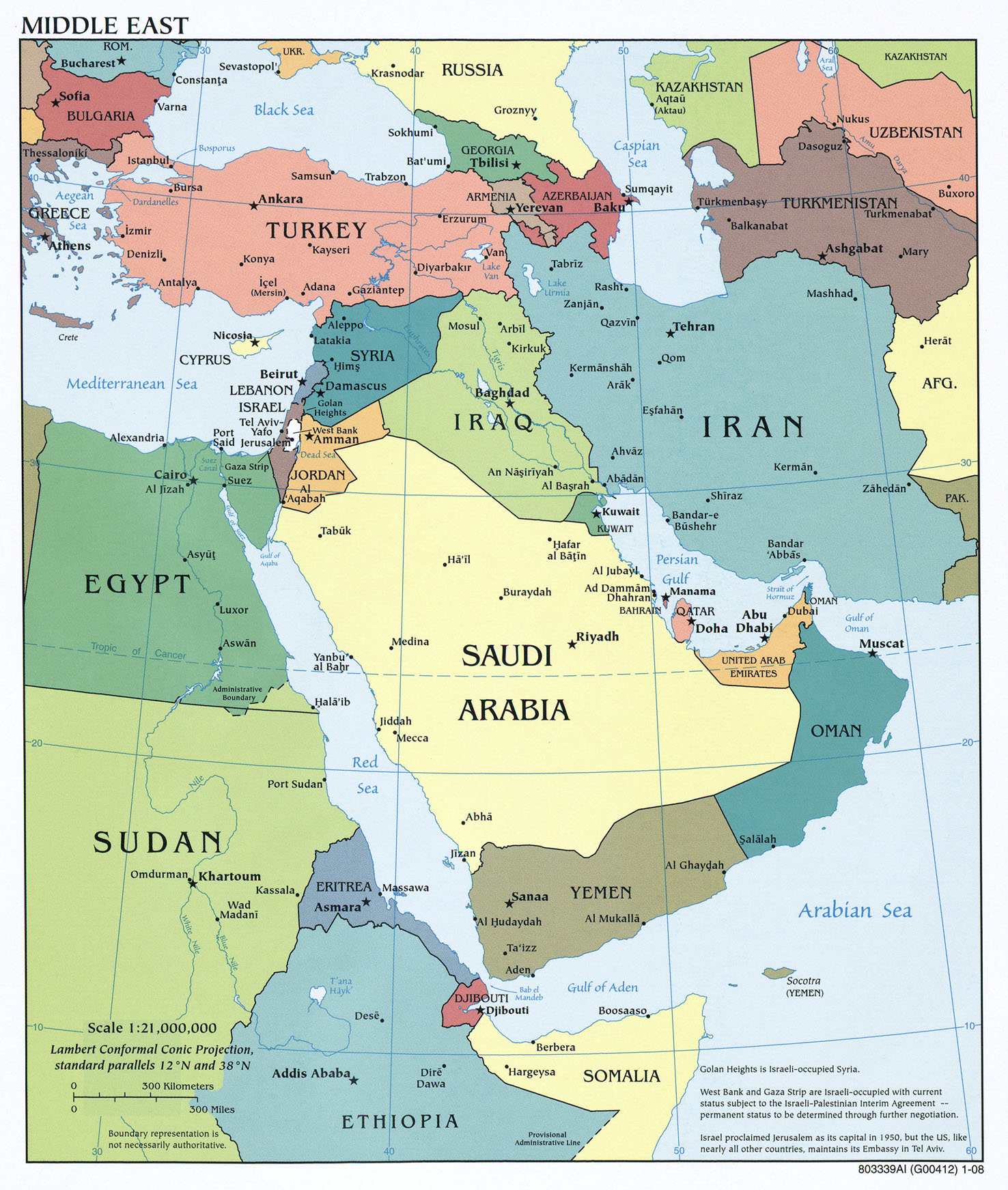
Oil producers in Syria's neighborhood ranked against all other countries in the world as of 2012 are as follows: Saudi Arabia (2nd, behind Russia), Iran (5th), Iraq (7th), Kuwait (8th), Egypt (25th), Turkey (54th), Israel (95th), and Jordan (96th). (In the age of jet warfare I am tempted to include the United Arab Emirates (8th) and Qatar (19th).) Turkey is more important than it seems because two major oil pipelines run through the country, one originating in Azerbiajan and the other originating in Iraq, that country's largest crude oil export line.

The general idea that Syria's neighbors hold the keys to a lot of oil certainly comes as little surprise to anyone with a cursory knowledge of the Middle East. But, the salient fact about the Syrian conflict is that it is a civil war. So, why is an American president so concerned about a war within the country?

That question leads to a second and even more salient fact. This civil war has now become a proxy for the Shia-Sunni split in the Muslim faith. Don't think: Catholics and Protestants in the United States. Rather think: Catholics and Protestants in Northern Ireland where a wide range of nonreligious issues sparked violence between the two groups for decades.

The split isn't just between countries that are predominantly Shia and predominately Sunni. It is, as Syria is showing, a split within many Arab nations which have citizens of both sects. So, there is not only the potential for conflict between nations in the Middle East, but also for the spread of civil unrest and civil war to other nations in the region. Iraq continues to demonstrate that this fear is not just hypothetical as bombings perpetrated in the name of minority Sunnis continue to vex a country which has experienced a long civil conflict between Shia and  Sunni after the U.S. invasion.

The spread of that kind of chaos would be very bad for oil supplies. Witness what has happened to Syrian oil production. It has fallen from 367,100 bpd in 2010 to just 157,200 bpd as of the end of last year. That's a decline of 57 percent in two years. That kind of decline in Middle East oil production would have catastrophic effects on an already iffy world economy, one absolutely dependent on oil for its smooth functioning.

The United States, as it turns out, has already been aiding the rebels for some time. The idea behind the aid may have been that the current regime might fall quickly, and the United States and its allies would have a solid relationship with those who take over.

With the stalemate continuing it's not obvious what strategy will work best to achieve America's number one goal in the region: stable oil production. One think tank academic even suggested that an ongoing stalemate was in America's best interests. Clearly, he doesn't believe the Shia-Sunni split will lead to conflict between or within other countries, at least on a scale that would prove troublesome.

But, there is one final consideration. After all we've been hearing about American energy independence, about growing domestic oil production, and about America being able to disengage from oil-exporting dictatorial regimes in the Middle East and elsewhere, the president seems as engaged as ever in the region.

There are three reasons for this: First, right now the United States imports just under half its oil needs. We produce a little over 7 million bpd and consume about 14 million bpd. Second, no realistic nonindustry assessment of future U.S. oil production suggests we'll stop needing substantial imports. Third, oil is traded in a world market, and its price is determined by world supply and demand. Any disruption in Middle Eastern oil supplies would lead to much higher prices which would ripple through the U.S. economy no matter how much we produce domestically.

The worldwide concern over Syria tells us that oil supplies remain tight and consuming nations remain very concerned about disruptions to supply. The oil price continues to hover near all-time highs when compared to the average daily price in 2011 and 2012, both record years. As the United States prepares plans for intervening militarily, there is not only much at stake in human terms, but also most assuredly in terms of critical oil supplies.

Kurt Cobb is an author, speaker, and columnist focusing on energy and the environment. He is a regular contributor to the Energy Voices section of The Christian Science Monitor and author of the peak-oil-themed novel Prelude. In addition, he has written columns for the Paris-based science news site Scitizen, and his work has been featured on Energy Bulletin (now Resilience.org), The Oil Drum, OilPrice.com, Econ Matters, Peak Oil Review, 321energy, Common Dreams, Le Monde Diplomatique and many other sites. He maintains a blog called Resource Insights and can be contacted at kurtcobb2001@yahoo.com.

Sunday, August 25, 2013

Are fracked oil and natural gas really "snake oil"?

It's not exactly clear where the term "snake oil" comes from. But, most everyone knows that it refers to any number of concoctions sold by traveling salesmen in the 19th century and claimed to have miraculous healing powers. Key to the pitch of these salesmen was the shill, a person working with the salesman, but who appeared to be a member of the audience. The shill feigned infirmity or illness and then offered to be treated on the spot with astonishing results.

The snake oil analogy seems apt for the hype surrounding the future supply of oil and natural gas extracted using the technique called hydraulic fracturing or fracking, for short. In his new book Snake Oil: How Fracking's False Promise of Plenty Imperils Our Future, Richard Heinberg takes on overblown claims from both the oil and gas industry's salesmen--its top executives, industry trade groups and PR firms--and its shills--fake think tanks, paid consultants, and captive analysts who are often quoted and interviewed (mistakenly) as independent experts.

Here in one volume laypersons seeking to make sense of the fracking story can find clear guidance. Heinberg separates the hype from the facts, demonstrating that fracking is not a panacea for the world's energy needs. Rather, it is the last short-lived gasp of the fossil fuel age as the industry seeks out ever more expensive and difficult-to-extract oil and natural gas deposits in order to forestall an inevitable decline--a decline which must be addressed decades in advance if we are to make a successful transition to an alternative energy economy.

How does Heinberg know all this? He knows this by looking at the data which he explains in a way that those who are not experts can readily absorb. Naturally, the industry assiduously avoids talking about the actual data from its own fracked oil and natural gas fields for that data bodes ill for the industry's future.

Heinberg takes pains to point out the industry's successes and its ingenuity in figuring out how to get oil and natural gas out of previously inaccessible deposits. But, the problems are fourfold. First, it's very expensive to do this. The industry's promise of cheap oil and natural gas for decades to come is an impossibility based on its own cost numbers.

Second, production from new wells runs down very quickly; some 30 to 50 percent of fracked natural gas must be replaced EACH YEAR before supplies can grow. The decline in the rate of production for fracked oil is up to 60 percent in the first year for new wells in the Eagle Ford deposit in Texas. I've seen an estimate of 42 percent PER YEAR for all wells there, new and old; but, that's still a wicked number. I've likened the situation to trying to run up a down escalator while the downward speed is increasing.

Third, as the industry drills these new deposits, government agencies and independent researchers are reducing dramatically their estimates of what the industry will ultimately produce. Information from actual wells tells them that these deposits are turning out to be like conventional oil fields with sweet spots in a few places and vast areas that will never yield profitable hydrocarbons.

Fourth, the environmental costs such as polluted and depleted water; contaminated soil; poisoned air; and induced earthquakes are growing with each drill bit that pierces the ground. In fairness, the industry is learning how to reduce these problems as it gets more experience with fracking. But the sheer scale of the drilling is likely to offset better practices as tens of thousands of new wells spread across the landscape to make up for the previously mentioned huge yearly production declines in existing wells.

A boom that was forecast by the industry to last for decades or even a century is therefore likely to end before this decade is out, Heinberg concludes. We ought be taking some of the energy from this newfound oil and natural gas, he says, and use it to build the renewable energy economy that we will surely need in the decades to come.

Instead, the industry, by spending relentlessly on public relations and broadcast advertising, has convinced policymakers and the public that the boom will extend for decades. And, so the United States remains on course to squander this temporary and modest windfall of oil and natural gas on a final orgy of energy consumption.

This is the heart of Heinberg's message. While other nations have long since accepted the need to move away from fossil fuels--both because they are finite and because they are major contributors to climate change--the United States is being lulled into a false sense of energy security. In the bargain the country is also increasingly ignoring the ravages of climate change that are becoming more apparent with each passing day.

The oil and gas industry knows that the promise of cheap, abundant energy is like a siren song to the American public. That's why the industry keeps pounding away in the media with its cornucopian message. But, like a siren song, that message, if not resisted, will lead to the equivalent of a shipwreck on an energy-starved island called the future.

Kurt Cobb is an author, speaker, and columnist focusing on energy and the environment. He is a regular contributor to the Energy Voices section of The Christian Science Monitor and author of the peak-oil-themed novel Prelude. In addition, he has written columns for the Paris-based science news site Scitizen, and his work has been featured on Energy Bulletin (now Resilience.org), The Oil Drum, OilPrice.com, Econ Matters, Peak Oil Review, 321energy, Common Dreams, Le Monde Diplomatique and many other sites. He maintains a blog called Resource Insights and can be contacted at kurtcobb2001@yahoo.com.

Sunday, August 18, 2013

The hype cycle: How the oil and gas industry manipulates investors and the public

What would you expect them to say?

That's the question you should ask whenever spokespersons for the oil and gas industry (or fake think tanks funded by the industry or analysts whose bread is buttered by the industry) announce a new find that is going to be a "game-changer" (or bigger than another well-known world-class field or enough to make America energy independent again).

Prepare yourself for another hype cycle in the U.S. oil and gas industry. The industry says it has found a deposit of oil that may turn out to be the largest in the world. The deep tight oil deposit goes by the name Spraberry/Wolfcamp and is located in West Texas. It's no surprise then that the industry is trotting out the America-as-the-new-Saudi-Arabia theme once again, a theme that many including me have shown to be pure bunkum.

[Clarification: If you click on the Spraberry/Wolfcamp link above, you'll read that it is not a new discovery, but rather discovered in 1943 and has been producing some oil since then. But the CEO quoted in the story cited just before that link stated that "Spraberry Wolfcamp could possibly become the largest oil and gas discovery in the world," thus leaving the impression that it was recently discovered. I can only surmise that this was part of the attempt to exaggerate what is actually happening. What's new is the application of high-volume slickwater hydraulic fracturing to the deposit, a specific and admittedly new variant on a 60-year-old technique. What I'm questioning in this story is whether that technique will, in fact, deliver what the executive promises. He says one thing; the data say another.]

And, the chief executive officer of Pioneer Natural Resources Company, which is currently touting its dominant position in the Spraberry/Wolfcamp deposits, added some bunkum of his own when he told The Dallas Morning News, "We’re more like a manufacturing operation than a traditional oil drilling operation.” This is the discredited notion that in tight oil and shale gas deposits, a company can drill anywhere and extract economical volumes of oil and/or natural gas. The idea has been discredited by the record of every tight oil and shale gas deposit drilled to date, deposits which settle down into a pattern of tightly focused "sweet spots" where drillers can make money and vast areas that are not profitable to drill--mainly because the oil and natural gas are too difficult to get out.

Though there are plenty of other reasons to doubt the claims about Spraberry/Wolfcamp, no one will know for certain what's true until the area is drilled and produced [much more broadly using high-volume slickwater hydraulic fracturing]. But, in order to drill it, oil and gas companies must raise billions in capital to pay for drilling and production costs. And, in order to do that, they have to get investors interested in plowing money into the drilling of actual individual wells through what are called private placements.

These placements are riskier than shares of oil and gas companies because they relate to specific drilling projects which may or may not succeed. On the other hand, such projects can be quite lucrative when they do succeed. Hence, the continuing attraction for the speculative investor.

Now, investors are not going to make such risky investments unless they believe the potential return is very high. Here's where the industry hype machine comes in. To raise the necessary capital, it is essential to get investors excited about particular oil and gas plays. The best way to do that is to create buzz in the media about the estimated size of the resources in the play. And, an easy way to do that is to invoke comparisons with Saudi Arabia and its giant oil fields as is being done in the case of Spraberry/Wolfcamp.

Many investors in such deals are not particularly sophisticated about oil and gas investments and so the hype works. The money flows in, the wells get drilled, and then the oil and/or natural gas flows or it doesn't. Or it flows, but not enough to justify producing it. Or it flows and is produced at a loss in order to get back at least some money.

Let's see what's already happening at Spraberry/Wolfcamp. First, we have the claim that Spraberry/Wolfcamp has 50 billion boe. For the uninitiated, boe is short for "barrels of oil equivalent." So, it's a mixture of oil and natural gas, but we are not made privy to how much of each is supposedly there. (About 6,000 cubic feet of natural gas contain the same amount of energy as a barrel of oil.) It's an important distinction since North American natural gas prices are so low that few operators are making any money from gas. Any emphasis on natural gas production in Spraberry/Wolfcamp should make investors skeptical about the profitability of selling more natural gas into an already glutted market.

Second, this number is labeled as "recoverable reserves" when it ought to be labelled "technically recoverable resources" which are based on very sketchy data that are continuously revised as drilling proceeds. And, just because something is technically recoverable doesn't mean it is economically recoverable.

What will ultimately be economical to extract will actually be only a tiny fraction of what is technically recoverable. And, in any case, we should remember that previous large estimates of technically recoverable resources in America's shale gas fields were later rather dramatically downgraded. Furthermore, neither technically nor economically recoverable resources represent "reserves" which are, of course, only that very small fraction of resources which can be produced profitably from known--that is, drilled--fields using existing technology at today's prices.

Third, one has to ask why Pioneer Natural Resources, one of the largest holders of drilling rights in the Spraberry/Wolfcamp deposit and the chief cheerleader for its exploitation, would almost immediately sell 40 percent of the company's stake to a foreign investor.

There are many reasons to sell a stake such as raising money for new ventures. But, Pioneer is telling the public that this deposit may be the largest in the world. Does the company really expect to do better than that with the money it received from the sale of a large portion of its interest? Or does the sale tell us that the company doesn't have as much faith in Spraberry/Wolfcamp as its pronouncements seem to indicate? Furthermore, this outside investor will also shoulder 75 percent of the "drilling and facilities costs" as part of the deal. Alas, the problem of finding money to drill the actual wells has in this case simultaneously been solved with other people's money.

The last time foreign investors came rushing into U.S. oil and gas deals was at the tail end of the shale gas boom, and they subsequently got clobbered. It has often been an indication that a boom is ending when foreigners flock to a particular American investment theme since foreigners are usually the last ones in.

This may have to do with the fact that even in the age of instantaneous electronic communication, it is still difficult to get a read on what is happening an ocean away until something has become a fairly big story in the media. (And, so it's no surprise that companies like to talk to reporters in highly optimistic tones as they seek outside investors.)

What ought to worry these late-to-the-party investors is the fate of those who invested not only in shale gas, but also in certain tight oil plays. (Tight oil is often mistakenly called shale oil which actually refers to oil made from oil shale, but that's a different story). Investors believe oil should be a better investment than natural gas since world rather than regional markets dictate the price, and that price continues hover near all-time highs based on the average daily price over the last three years. There is something to this logic unless the amount one is able to extract is small. And, that's what is happening to investors in the Colorado and Ohio tight oil deposits who thought they were in for a bonanza. Both regions were heavily touted, and both turned out to be huge disappointments.

A few reporters are starting to catch on to the pattern and including dissenting voices in their coverage. And, a just recently retired industry CEO has now said publicly that the shale gas and tight oil story is overblown. Mark Papa, former CEO of EOG Resources, which has extensive positions in both shale gas and tight oil, told Forbes recently: “The chances of the U.S. being independent in oil are very slim.” He added, "We’ve studied this from the rocks’ point of view. There’s a whole lot of plays that will have zero significance."

It's possible that Spraberry/Wolfcamp will turn out to be a very profitable venture for oil and gas companies with holdings there. Pioneer Natural Resources has already made a considerable sum by selling a 40 percent share to someone else. And, it's possible that even individual investors in wells may end up glad they invested. No one can know for certain. But all indications are that these investors should not base their decisions solely on the information coming from the industry.

Unfortunately, the public--which mistrusts the oil and gas industry almost universally--for some reason takes the industry's self-interested pronouncements about supply at face value. Perhaps this is because the public does not understand the true purpose behind these pronouncements.

Beyond the industry's desire to raise capital and sell off assets at a profit, the hype cycle aids industry trade groups such as the American Petroleum Institute (API) in propagating doubtful stories implying America is about to become energy independent. (The API has stopped making explicit statements on this subject which it knows are unsupported by the data. Instead, it keeps repeating the word "abundance" to give the impression that the country is or will soon be energy independent.)

The purpose of such stories is not particularly patriotic. Rather, these stories are designed to slow the transition to alternative energy sources by making such a transition seem far less urgent. In the process, the API is able to protect the value of its members' underground inventories of oil and natural gas, some of which might become stranded or at least less valuable in the event of a rapid transition to alternative energy.

As the reality of tight oil and shale gas sets in, even energy analysts--who so often parrot what the industry tells them--are starting to look skeptically at industry claims:

"Oil companies take production data from existing wells and extrapolate it over an entire field that might be millions of acres. And the oil business is rife with cases of fields that were the next big thing but ultimately produced nowhere near early estimates," said Benjamin Shattuck, an analyst with the energy research firm Wood Mackenzie.

If the analysts are finally looking skeptically at industry pronouncements, you should, too. Don't fall victim to the emerging hype cycle over Spraberry/Wolfcamp or the next cycle over something else, or the next one after that.

PLEASE NOTE: Clarifications are in brackets [].

Kurt Cobb is an author, speaker, and columnist focusing on energy and the environment. He is a regular contributor to the Energy Voices section of The Christian Science Monitor and author of the peak-oil-themed novel Prelude. In addition, he has written columns for the Paris-based science news site Scitizen, and his work has been featured on Energy Bulletin (now Resilience.org), The Oil Drum, OilPrice.com, Econ Matters, Peak Oil Review, 321energy, Common Dreams, Le Monde Diplomatique and many other sites. He maintains a blog called Resource Insights and can be contacted at kurtcobb2001@yahoo.com.

Sunday, August 11, 2013

America: Exporting our way to energy independence?

Never let the facts get in the way of a good story. That's the credo of the oil and gas industry as it continues to lobby for increased oil and natural gas exports from the United States. After all, the industry claims, we're on our way to achieving energy independence, and we can help our balance of trade by exporting the extra hydrocarbons we produce. The data, however, contradict the industry's claim.

Even as the Obama Administration approved the country's third natural gas export terminal, the United States remained a net importer of natural gas. Production in the United States averaged 69.5 billion cubic feet (bcf) per day this year through May, the latest month for which data is available. But the country consumed 76.9 bcf per day. It IMPORTED almost 7.8 bcf per day from Canada. And, then it EXPORTED about 1.8 bcf per day to Mexico, a number that is likely to rise as pipeline export capacity to Mexico expands. (Both Canada and Mexico are part of an integrated North American natural gas pipeline system.)

The latest approval would lift the capacity for daily liquefied natural gas (LNG) exports from the United States to 5.6 bcf per day or about 8 percent of what we currently produce. The exports would be shipped using special freighters to Europe and Asia. Strangely, these exports would make it necessary for the United States to IMPORT more natural gas in order to support current consumption! The situation seems surreal, and yet, additional approvals for LNG exports are likely in the future.

Natural gas producers keep telling the public and policy makers that U.S. natural gas production is set to grow continuously for decades as they tap large shale gas resources using hydraulic fracturing. But the story isn't holding up. U.S. natural gas production has been moribund, bouncing along a plateau from January 2012 through May of this year (the latest month for which data is available). Monthly production last year averaged 2.11 trillion cubic feet (tcf), but was slightly less through May of this year at 2.10 tcf per month. This is despite prices that have nearly doubled from the lows in April 2012.

It's possible that the situation could change, but unlikely for two reasons. Production decline rates for natural gas wells in the United States are averaging around 32 percent PER YEAR. That means about one-third of U.S. production must be replaced EACH YEAR just to stay flat. And, that's really all that we've been doing for the last year and a half.

But the situation is likely to get much worse. Here's why: Gas from shale deposits is rising as a percentage of total U.S. production. Shale gas wells decline much faster than the current overall rate (which includes conventional gas wells), between 79 and 95 percent in the first three years. That means some 80 to 90 percent of all existing shale gas production must be replaced every three years. With shale gas, it is as if we are on a down escalator trying to go up; but, the down escalator, in this case, is increasing its speed, making any upward progress difficult, if not impossible.

Now, the Congress and the president could make the argument that oil and natural gas producers ought to have the right to sell their products to the highest bidders wherever those bidders are in the world--just as farmers and manufacturers in the United States do. This is a plausible and defensible position, well within the American experience. But this is NOT the argument they are making. And, it's doubtful that it would be a very popular one, for it means higher energy prices for Americans.

It's possible that the Congress and the president are just pretending that natural gas production is continuing to rise. In that case, they are knowingly deceiving the public--not the first time, of course, that public officials have done this. But, what would be worse is if they simply don't know the actual data. Then, they they must be labeled as grossly incompetent since the production, consumption and import data discussed here are all available online from the government's own U.S. Energy Information Administration.

The same analysis applies to American oil exports, but even more so. U.S. crude oil imports remain slightly higher than U.S. crude oil production. It's true that a portion of those imports are turned into finished products such as gasoline and diesel and then exported. But even after adjusting for this, the country continues to import just under 50 percent of its crude oil needs.

So, the rapidly increasing rail shipments of oil to Canada that we are witnessing do NOT reflect an America producing more oil than it needs. These shipments simply reflect an oil industry taking advantage of the higher prices that customers in eastern Canada are willing to pay.

(Wait a minute, you must be thinking, I thought Canada was a major oil exporter. It turns out that Canada is both an importer and exporter. For a more detailed explanation of this strange situation, see "Canadians could free themselves from oil imports, but will they?")

So, the real reason that the oil and gas industry wants a loosening of restrictions on exports of American-produced oil and natural gas is so that it can take advantage of higher prices abroad. This is particularly true for natural gas which sells in the United States for $3.32 per cubic feet (Henry Hub - August 9), but $11.60 in Europe (July 31) and $17 in Japan (July 31), a good proxy for Asian prices. There are costs involved in liquefying the gas for shipment via freighter. But, the profit margins are far greater than the profits currently available from domestic sales. In fact, there is reason to believe that major international oil companies which bought huge positions in U.S. shale gas plays a few years ago have been losing money ever since on those positions when all costs including the costs of acquisition are taken into account.

As a matter of policy, higher natural gas and oil prices within the United States would spur the deployment of renewable energy by making it more competitive. Maybe this is the secret agenda of the Congress and the White House. I very seriously doubt it. I think both are simply bowing to the wishes of the oil and gas industry, while hoping the public doesn't find out what's really going on. Worse yet, the Congress and the president may not really understand what's going on themselves.

Kurt Cobb is an author, speaker, and columnist focusing on energy and the environment. He is a regular contributor to the Energy Voices section of The Christian Science Monitor and author of the peak-oil-themed novel Prelude. In addition, he has written columns for the Paris-based science news site Scitizen, and his work has been featured on Energy Bulletin (now Resilience.org), The Oil Drum, OilPrice.com, Econ Matters, Peak Oil Review, 321energy, Common Dreams, Le Monde Diplomatique and many other sites. He maintains a blog called Resource Insights and can be contacted at kurtcobb2001@yahoo.com.

Sunday, August 04, 2013

Of boiling frogs and oil prices

Many readers will know about the claim that a frog plopped into boiling water will hop right back out if it can, while one put into cold water which is then slowly heated will remain until it is cooked. The claim is wrong, but the story is quite useful in understanding some human behavior. Gradually changing circumstances are typically more difficult for humans to detect and react to than circumstances that are changing rapidly.

Such is the case with oil prices. The velocity with which oil prices rose in 2007 and 2008 transfixed the public and policymakers. The price vaulted from $60 a barrel on the first trading day of 2007 to above $147 on July 11, 2008, the (so far) all-time high.

At the time many believed that oil production might be reaching a limit that would never be breached, a possibility with dire implications for a society deriving more than a third of its energy from oil and dependent on the substance as a basis for myriad products such as plastics, pharmaceuticals, herbicides, pesticides, lubricants, heating fuel, fabrics, paints, solvents, and asphalt, just to name a few.

When oil prices then plunged as a result of a crashing economy, no one knew what to expect except those of us who had been following the supply picture carefully. That supply picture suggested rapidly recovering prices as the economy rebounded. As it turned out, the spot price rose from just under $34 per barrel on December 26, 2008 to $126 on April 28, 2011. Again, the spectre of limits hung over the market and the public.

Now, the strange thing is that the worldwide average daily price hit records in both 2011 and 2012 if we go by the Brent price which has come to represent the true world price. And, we may be headed for another record this year. But the rise has been so incremental from $111.26 in 2011 to $111.63 in 2012 that it can hardly be called a rise. Like the proverbial frog in gradually warming water, the public has become used to high oil prices and so doesn't often think about what they imply--namely, continued constrained supply despite all the distracting and misleading histrionics from the industry claiming that we've entered a new era of abundance. Oil's persistently high price is, of course, an embarrassing and decisive indicator that the claim is nonsense.

So far this year, the daily Brent crude price through July 30 has averaged $107.43. Will it rise enough from here to top 2012's average? We cannot know. But the fact that oil prices have remained in or near record territory for two years running no longer elicits alarm from the public, the industry or policymakers. High prices have become the new normal. This is the ever so slightly warming water in which we frog-humans are sitting while no longer noticing the change (or remembering how unnerving it was as prices rose rapidly to this level).

It's worth remembering that the current average price for the year remains well above the average daily price for all of 2008, the year that stunned the world with the highest oil price ever. The 2008 average was only $96.94, again using Brent crude prices as a proxy for world prices.

Like the frog, for us humans it is the velocity of price changes which grabs our attention, not the persistent high price. The reason for the high price is clear. Demand remains robust, especially in Asia, and supply remains constrained. As I pointed out last week, supply has only advanced a paltry 2.7 percent in seven years vs. about a 1.5 percent increase on average EVERY YEAR prior to that (from the early 1990s onward) for crude including lease condensate (which is the proper definition of oil).

We have come to accept high-priced oil, and we will probably accept it until the next crisis causes prices to bolt quickly upward getting our attention again. As Nassim Nicholas Taleb, the former hedge fund manager, self-styled philosopher of risk, and author of The Black Swan tells us, the longer a system appears stable, the greater the disruption will be when stability breaks down.

Oil prices have been on average at their highest ever for the past two years and may reach a record again this year. But they have also essentially been stable because the change in the average daily price has been so slight. Watch out for what comes next after that stability evaporates.

Kurt Cobb is an author, speaker, and columnist focusing on energy and the environment. He is a regular contributor to the Energy Voices section of The Christian Science Monitor and author of the peak-oil-themed novel Prelude. In addition, he has written columns for the Paris-based science news site Scitizen, and his work has been featured on Energy Bulletin (now Resilience.org), The Oil Drum, OilPrice.com, Econ Matters, Peak Oil Review, 321energy, Common Dreams, Le Monde Diplomatique and many other sites. He maintains a blog called Resource Insights and can be contacted at kurtcobb2001@yahoo.com.

Sunday, July 28, 2013

My energy-rich move across America

Someone once said that the journey is more important than the destination. Given the amount of energy global society consumes each day simply moving people and things from one place to another, we can conclude that this shibboleth has taken hold, but not quite in the way we had expected.


My journey--a relocation, actually--across America from Michigan to Portland, Oregon is illustrative of the casual attitude most of us have toward energy consumption, particularly that devoted to transport.


The pod: Crammed, but not full

First, there was the so-called pod which I rented for the journey, a box 7 X 7 X 8, into which I crammed all my worldly goods--less the numerous items which had become superfluous and which I had thrown away, given away or recycled. (I know, I know, there is no "away.") The pod is really a version of containerized freight for mere civilians moving their households. The worldwide logistics system--a system that will only function so long as transportation fuels remain affordable--has found its final conquest.


A friend skilled in packing for maximum utilization of space assisted me in loading the pod. He said he once packed a truck for one of his family moves so tightly that only a liquid cargo would have used the space more completely. As it turned out, a mandatory weigh-in at a state police weighing station revealed that his truck was overweight for its class. And so, with his help we were able to pack everything I wanted to take and even had room to spare.


Off went the pod the next day, picked up by a device that might have been an arachnophobe's mechanical nightmare. The spider-like crane lifted the pod off the ground and placed it onto a flatbed truck for delivery into a logistics system which moves nearly weightless plastic housewares and heavy metal ingots with equal ease and profit across oceans and continents.

Pod crane: An arachnophobe's mechanical nightmare

Two days later my car journey west began. My father accompanied me--the first trip in 29 years that included just the two of us. In the weeks preceding the trip, people were telling me how happy they were that gasoline seemed to want to stay under $4 a gallon this summer. Such short memories and warped perspectives, I thought, aided and abetted, of course, by oil industry propaganda about rising supplies--really, very, very marginally rising, a paltry 2.7 percent in seven years vs. about 1.5 percent on average EVERY YEAR prior to that for crude including lease condensate (which is the proper definition of oil). The public by and large does not understand that we have passed into a new era of high-priced oil.

In the first leg of my trip, we raced across Lake Michigan in a fast-running ferry that carried cars and passengers to Milwaukee in just two and one-half hours. Opposite our starting point we had spied the Milwaukee Clipper, now a museum and a reminder of an era when ferries just carried people (though this one was eventually refurbished and outfitted for carrying vehicles).

The relative ease of crossing the Great Plains--straight, flat roads--makes it easy to forget that some of the fuel powering my vehicle was ethanol from corn grown on these prairies--demand for which is driving up food prices.

A stop in Rapid City, South Dakota had me reciting James Mason's lines from the Hitchcock thriller, North by Northwest. Those who have seen the movie know that its climactic scene is staged on Mount Rushmore, home of the mountaintop sculptures of George Washington, Thomas Jefferson, Theodore Roosevelt and Abraham Lincoln. The combined sculpture is a testament to the gigantic dreams of America which have led to great achievements, but also more lately to a morbid gigantism in cars, houses and office buildings as a substitute for real achievements.

Hitchcock's America in 1959 was wealthy, comfortable and oblivious to nearly everything except the Cold War and the traffic in secrets that was the ostensible subject of the film. America's peak in oil production was still 11 years away and few then could imagine a country beholden to foreign powers for oil imports which--despite industry misdirection--remain substantial and are critical to our way of life to this day.

Devil's Tower to humans: I'll be around longer than you

We stopped briefly at the Badlands and then at Devil's Tower. This latter site is a testament to what makes much of the West so astonishing to see--the simple fact of differential rates of erosion. Different types of rock erode at different rates, and since the Earth's subsurface is rarely uniform in its composition, erosion creates the topography we see. Saying it this way deflates the experience, however. To the naked eye, the West is nothing less than astonishing in its physical features in a way that photographs will never capture.

To understand the time line for such formations as Devil's Tower--tens of millions of years--is to come into contact with an Earth which cares little about our existence and probably will have obliterated all memory of us tens of millions of years hence. We like to think of ourselves as the highest outcome of evolution. But, on such time lines we are merely an intermediate and perhaps not very impressive product, considering what might yet happen in the vast stretches of time to come before a dying Sun turns Planet Earth into a cinder.

At Yellowstone Park I saw the Old Faithful geyser for the first time (other than in photos and video). The heat beneath Yellowstone is a warning that at any time a vast explosion could hurl untold millions of tons of debris into the atmosphere, smother much of the western United States (as it did approximately 640,000 years ago) and reduce sunlight to the rest of the globe for many years. We almost always think in terms of how we can harness energy from nature and not how nature's mighty stores of energy might clobber us.

From there it was on to the marvel of engineering that is an interstate highway winding its way through river gorges and mountain passes. Other more confident (reckless?) drivers sped past us on the curves and steep downslopes that rather suggested caution to me.

I was reminded of an exchange I had with my sister many years ago when I took up bicycling in earnest. She said that the vast majority of drivers are courteous to cyclists. My response was that it only takes one who isn't courteous to kill you. The extreme outcome, the supposed outlier, is always on my mind, but on the mind of few others. In some ways that may be a good thing for it is not clear to me how this tightly networked, just-in-time world we've constructed would function unless possible extreme outcomes were ignored (as they routinely are).

The final mountain pass delivered us downward onto a sere plain of what appeared to be winter wheat, some of which was being harvested by combines. One-hundred-degree heat baked these eastern Washington state farms that day, heat that is a legacy of our profligate, but until quite recently, unconscious burning of fossil fuels, the major force behind man-made climate change.

Not far away lay the Columbia River, a vast, energetic artery of western-flowing water harnessed to serve the water and power needs of the American Northwest. As I walked along the river in front of the inn that would mark our final night's stay before entering Portland, the Columbia looked not so much like a river, but a lake--made slumbering and weary by dams downstream.

Bonneville Dam spillway

The next day as we drove on the interstate along the banks of the Columbia, we found those dams, massive walls of concrete and steel spanning the river at three separate and amply-spaced intervals. The churning water at their bases gave witness to a controlled flow that generates electricity--electricity dispatched through thick wires hanging from giant metal towers and destined for the energy-hungry metropolises and hamlets of Oregon, Washington and possibly other areas.

Mt. Hood: Dormant, but not dead

The parched brown landscape gradually grew greener as we approached Portland. We passed Mount Hood, the highest spot in the state and a dormant, but not extinct, volcano. (The last eruption is thought to have been between 170 and 220 years ago, though it was not a major explosive event).

In our travels so far we had not worried about finding a room for the evening or about whether there would be enough gasoline to fill the car or about whether the restaurants and grocery stores would run out of food. Of course, not! This is America as it hovers near its highest rate of energy consumption in history. Everything seems fine, everything works more or less as expected--even though an irreversible decline may arrive in the not-too-distant future.

Overconfident, we drove to the center of Portland believing we could easily find a hotel room. (We had arrived early and the pod was not due for another three days.) But three medical conferences and the usual flush of summer tourists had filled nearly every downtown hotel to 100 percent of capacity. A list of possibilities given to us by a sympathetic doorman at the first hotel we tried led to a frantic search by cellphone until we found something on the edge of the downtown area, but only for two nights.

Luckily, two nights turned into three and then, unluckily, into four and five as the pod failed to appear on schedule--a breakdown in the worldwide logistics system, at least for me. Pleasant evenings that we at first filled with restful waterfront meals of fresh seafood turned into a finger-tapping waiting game with little to do but shop for some previously anticipated needs and tour the city with an aimless demeanor.

When the pod did arrive, friends who had promised to help unload on a Saturday were occupied at work on a Monday. That left my 88-year-old father and me to do the unloading.

As is sometimes the case, circumstances make the man. My father worked like a stevedore to bring boxes by hand cart to the bottom of the stairway that led to the apartment. I carried the lighter ones up the stairway and transported others too heavy to carry by dragging them up on a hand cart backwards.

I had predicted it would take us only two hours to unload with the help of friends, and yet, with just the two of us, it took slightly under two hours in the 90-degree heat. My father then slumbered for a couple of hours in a studio chair on the porch as I started to open boxes and arrange things.

This man, who hit his stride professionally during the sweet spot of the fossil fuel age, is a testament to what strenuous daily exercise, a healthy diet, an engaged mind, and a wealth of friends can do to extend the vigor of the thermodynamic system we call the human body. We don't often think of the human body as an energetic system, but we should for we would all then recognize what my father recognizes: energetic systems require continuous flows of activity and proper fuel even when those systems are aging human bodies.

The next day he did what is arguably the most potent single act anyone can undertake against climate stability: He boarded a plane for home. Because jets fly so high in the atmosphere, their emissions have a disproportionately large effect. We could congratulate ourselves for having used public transportation to get him to the airport, but little else. We had looked into train travel. But the two-day return trip alone on a train seemed an unnecessary delay for a man who felt he had been away too long and needed to return to his wife's side quickly. Perhaps on a future visit he would take the Empire Builder to Portland and back.

And so, I begin my life in Portland, a city powered by the hydroelectric generators hidden inside the dams I saw on the Columbia. The electricity produced in comparison to fossil fuels is relatively benign--unless, of course, you are a salmon, whose upstream journey was blocked until fish ladders were installed or unless you are a fisherman who has witnessed declining catches of these fish.

Every action has consequences, even if they are visited on someone else. This is an awareness that I found more widespread in Portland than anyplace else in America I had previously visited. And, Portlanders frequently remember to ask whether it's fair for one person to bear the costs of another's action, believing that thorough consideration and discussion ought to ensue in such a case. It's the kind of thinking that made me want to move here. And, it's the kind of thinking that offers the possibility of getting us out of the mess we have gotten our society and our planet into.

Photo Credits: Pod and pod crane, Olga Bonfiglio (reproduced with permission); Devil's Tower, Bonneville Dam, Mt. Hood, Wikipedia Commons

Kurt Cobb is an author, speaker, and columnist focusing on energy and the environment. He is a regular contributor to the Energy Voices section of The Christian Science Monitor and author of the peak-oil-themed novel Prelude. In addition, he writes columns for the Paris-based science news site Scitizen, and his work has been featured on Energy Bulletin, The Oil Drum, OilPrice.com, Econ Matters, Peak Oil Review, 321energy, Common Dreams, Le Monde Diplomatique and many other sites. He maintains a blog called Resource Insights and can be contacted at kurtcobb2001@yahoo.com.

Sunday, July 07, 2013

No posts next three weeks - Moving to Portland, Oregon

I am about to relocate to Portland, Oregon and have had little time to write. I don't like to slap pieces together just to get something posted, and so I'm suspending my posts until late July by which time I expect to be settled in. I anticipate that I will post again on Sunday, July 28.

As always, I am gratified to be writing for such an intelligent and engaged group of readers, and I look forward to continuing our conversation soon.