Sunday, November 03, 2013

Does the Earth need saving?

Hardly a day goes by without someone writing or saying that we need to save the Earth. My geologist friends scoff at such language for semantic reasons. The coolish, rocky planet that we call Earth will be fine when humans are long gone, they say.

Yes, climate change and human depredations of the biosphere have already brought many species to extinction and will likely extinguish many more. And, the radioactive wastes we leave behind might very well get spread about the Earth in ways that are destructive to life. But give the Earth a few hundred million years, and all of this will be essentially forgotten, gone without a trace.

As for life, it is doubtful that the consequences of human actions, however extensive, could wipe out every trace of life on the globe. Some form of life is likely to survive anything we as a species ultimately throw at it and then begin the cycle of evolution all over again.

So, if the planet doesn't need saving, what does? Well, two things depending on your goals. Many people believe that humans are moving quickly toward premature extinction, and, as I mentioned above, that we are taking many species with us. So, if your goal is to maintain the continuity of the human species, you presumably have your work cut out for you--or maybe not depending on the result you'd like to see.

We humans are almost certainly in overshoot, a term from population biology that means we've exceeded the long-term carrying capacity of the Earth for humans given our current technology and consumption habits. So, here's the solution. Bring the per-capita consumption of humans down drastically or drastically reduce the number of humans consuming at our current rate. The first seems nearly impossible given our system of governance and technology and the fact that there are so many poor people who aspire to higher levels of consumption. The second seems impossible even though we have highly effective and cheap contraceptive technology that would over the course of the next century enable us to reduce our numbers down to one billion. (This assumes that average fertility is no more than one child per couple.)

There is a third solution. And, that is simply to let nature take its course and thin human numbers through plagues, food and resource shortages, climate-related catastrophes and the collapse of our complex global economic network that might ensue. Even with all of this, humans are extremely resilient, and enough of us would likely survive to create a new system of living based on the available resources under the new climate conditions on Earth.

It seems that human continuity is relatively assured no matter what. So, what we are really talking about saving is not the species, but the way of life we currently enjoy and the number of humans who currently enjoy it (using the term in its broadest sense since the world's vast sea of poor people must enjoy it without the material benefits of citizens in wealthy countries).

There is certainly an interest in protecting one's children and grandchildren who may face an increasingly perilous climate and shrinking resources including food. And, there is a broader concern that the world's poor will bear the brunt of these problems resulting in skyrocketing death rates.

But, some people have an even more wide-ranging concern for all the other creatures and plants which inhabit the Earth. In general, they form a web of life that provides us with services not accounted for by our money-driven economy, so-called ecoservices which according to the Encyclopedia of Earth do the following:

  • Moderate weather extremes and their impacts
  • Disperse seeds
  • Mitigate drought and floods
  • Protect people from harmful ultraviolet rays in sunlight
  • Cycle and move nutrients
  • Protect stream and river channels and coastal shores from erosion
  • Detoxify and decompose wastes
  • Control agricultural pests
  • Maintain biodiversity
  • Generate and preserve soils and renew their fertility
  • Contribute to climate stability
  • Purify the air and water
  • Regulate disease carrying organisms
  • Pollinate crops and natural vegetation

We could not survive without these ecoservices and would be bankrupted if we had to provide them completely artificially. Their scope and complexity are something on which our entire global society depends and gets essentially free of charge.

So, a concern for the well-being of all the other creatures and plants which inhabit the Earth is partly an act of self-interest in survival. Beyond this, there are aesthetic, cultural and moral reasons for preserving these other living things. For instance, it is sad to imagine a world without the beauty of the tiger. But we may someday inhabit such a world.

We inherited a rich diversity of edible plants, but have been narrowing the ones we continue to raise based on our ability to grow vast quantities with modern farm machinery and methods--and our ability to store, ship and market crops across long distances. A part of our cultural as well as our genetic heritage is being lost.

Then, there is the moral argument. Deep ecologists suggest that all life has intrinsic worth and that therefore to exploit and destroy other life except to satisfy basic needs is a moral failing. For deep ecologists, then, preserving life on Earth means much more than simply preserving human life.

So, next time someone tells you he or she wants to save the Earth, you might inquire, "Which part? And for what or whom?" It's a vital clarification. If you only wish to save the human species consuming at its current level, then humans will surely continue to impoverish the plant and animal kingdoms. And, we humans might ultimately see our numbers diminished considerably by forces beyond our control if we insist that consumption go up or stay the same, rather than go down.

However, if your goals are broader, those goals may require far-reaching changes in human society as it is currently configured. So, yes, go out and save the Earth. But, you would do well to understand which part you want to save and for what or whom you want to save it.

Kurt Cobb is an author, speaker, and columnist focusing on energy and the environment. He is a regular contributor to the Energy Voices section of The Christian Science Monitor and author of the peak-oil-themed novel Prelude. In addition, he has written columns for the Paris-based science news site Scitizen, and his work has been featured on Energy Bulletin (now Resilience.org), The Oil Drum, OilPrice.com, Econ Matters, Peak Oil Review, 321energy, Common Dreams, Le Monde Diplomatique and many other sites. He maintains a blog called Resource Insights and can be contacted at kurtcobb2001@yahoo.com.

Sunday, October 27, 2013

The problem with (affordable) helium

If I had had space, I would have included a subtitle for this piece as follows: Things do not have to run out to become unavailable. So, now you have a general idea about the problem with helium, a problem to which I'll return shortly. But, first let me discuss the broader issue my subtitle enunciates.

How many times have you heard someone say that we have huge quantities of such and such a resource underground (or even in seawater), so there is nothing to worry about? It is hard to know where to start with this simplification because it comes from minds that are so egregiously uninformed.

There are dozens of reasons that things can become unavailable before they ever "run out." It is a favorite ploy among cornucopians (mostly economists) to accuse those warning of resource shortages of saying that some particular resource, say oil, is running out. But that is not what they are saying at all. Rather, the realists, as I call them, are simply pointing out that a number of factors are coming together than may raise the cost of obtaining such resources beyond the means of many to afford them.

The rich will pay whatever price is necessary for their food and energy. These are small percentages of their income even if food and energy costs double, triple or go up 10 times. But such is not the case for the vast majority of humans on the planet. At some price, food becomes unaffordable, gasoline becomes unaffordable, and even drinkable water become unaffordable.

What this tells us is that the smooth functioning of the global system depends not just on resources, but widely affordable resources and the products and services they make possible. Whatever the causes of an affordability problem are, millions and even billions could go without adequate food and fuel as a result. Many on the margins would become ill from inadequate nutrition, some might starve outright, and many could freeze for lack of warmth in cold climates.

Perhaps all this is too dramatic just yet. So let's take an example of something which has already become suddenly and unexpectedly less available: Helium.

Helium is the second most abundant element in the universe after hydrogen. But, on planet Earth it is exceedingly rare. The main source is decaying radioactive minerals in the Earth's crust which emit helium nuclei as part of their decay process. A small portion of this helium gets trapped in natural gas reservoirs. The rest makes its way into the atmosphere and then into outer space. Very few gas reservoirs are rich enough in this trapped helium to make it worthwhile to extract, process and get to market. Unless we find another affordable source of helium, this means that helium production will necessarily peak and decline when the helium-rich natural gas reservoirs that hold it peak and decline.

It wouldn't matter so much that helium is becoming hard to get if it were not for the fact that for many applications there is no substitute, none. Let me quote at length from a piece I did more than four years ago entitled "Let's party 'til the helium's gone":

Perhaps the most important uses of helium are in its liquid form. Helium is the gold standard for low-temperature processes and research. In its liquid state it can reach temperatures as low as -459 degrees F or almost absolute zero, the temperature at which all molecular motion would cease. (No one has ever succeeded at reaching absolute zero, and theoretically, it is thought to be impossible to achieve.)
Liquid helium simply has no equal. Currently, it is critical in magnetic resonance imaging, a non-invasive diagnostic procedure that allows physicians to obtain images of many tissues and organs, notably the brain, that are superior to those provided by X-rays. This is an application for which superconductivity is critical, and very low temperatures are essential for optimum results. In addition, superconductivity is an area of intense ongoing scientific research for ways to reduce electricity losses in the electrical grid and increase the efficiency of power storage and electric motors.
Perhaps the most visible use for helium beyond filling balloons is that in filling airships or blimps. More exotic uses include rocketry where helium is used to flush out fuel tanks and then prepare [that is, condense] liquid oxygen and hydrogen for those tanks. Helium is preferred for this work and for blimps because it is nonflammable and inert, that is, under ordinary circumstances it doesn't chemically combine with other elements.
These two properties also make it ideal as a shielding gas for certain types of critical welding. Preventing normal atmospheric gases from reaching a weld can enhance its strength and quality. The same properties make helium critical for producing silicon wafers, the basis of today's electronic world.
In addition, helium is used for heat transfer in gas-cooled nuclear reactors, and it is used to check for leaks in critical equipment because it flows more readily through such leaks. There are many more uses, both industrial and scientific, but you get the idea.

First, we are not running out of helium. What's happening is that the U.S. government, which for years dominated the helium business, has been gradually getting out.

All this was telegraphed a long time ago to industry. In 1996 the U.S. Congress passed a law mandating that the government get out of the helium business by 2015. That was supposed to give plenty of time for the private marketplace to pick up where government would leave off.

But, it hasn't turned out that way. Congress let the Federal Helium Program set prices too low in order to hasten the liquidation of its stockpile. Those low prices kept away potential new entrants into the helium business. And, now as the federal program ratchets up the price to address the problem, consumers of helium are yelling "ouch." And yet, at the same time there are few new players to replace the dwindling federal supply in the market.

It's not clear what price helium would have to rise to in order to incentivize private development. Since 1925 the U.S. government has essentially dominated the market, so there is no historical free market price to look at. One would have thought that with the impending government withdrawal from the market, some savvy entrepreneur would be stockpiling helium for the day when the price would skyrocket.

But such is not the case. For one thing, it takes an extensive infrastructure to capture helium from natural gas fields and thus a huge investment, one that few would undertake without reasonable assurances that prices would rise to cover the costs.

But perhaps even more important, U.S. sources are the world's most prolific. Nothing compares to them. And, this is not simply a question of incentivizing people to go out and look for economical deposits of helium. Helium currently is found only in commercial quantities in natural gas reservoirs and then only certain ones. All the richest sources, therefore, are already being produced.

The only course then is to raise the price of helium to a level where much leaner resources of helium could profitably be extracted from natural gas reservoirs, prices high enough to justify huge capital outlays. Keep in mind that separating helium from natural gas requires temperatures of -315 degrees F.

As prices rise to make these more-costly-to-get helium resources available, who will be priced out of the market? Right now, it turns out, people who want helium for party balloons are willing to pay the most. It's a small part of the market, but it shows that the distribution of helium in a higher cost world might not turn out to be what most of us would think is socially desirable. Many research labs might not be able to afford as much. Other critical uses in medicine and computer chip manufacture might be curtailed or result in considerably higher costs for medical diagnosis and electronic equipment.

All this is to demonstrate that a resource does not have to "run out" in order for it to become unavailable to large numbers of people. There are plenty of molecules of helium in the Earth. But the cost of getting them out for all who want to use them, even for critically important purposes, might be too high for many to bear.

The same analysis can be done for other finite resources, oil, coal, natural gas, rare earth minerals, lithium and many more. The cornucopians like to say that we will never run out of what we need. The market will provide the necessary incentives for getting more out of the Earth more efficiently or for finding substitutes. We will always have what we need when we need it at prices we can afford in the quantities we require.

But, there is no guarantee that this will happen in every instance that we want it to. As such the above assertion is simply an article of faith in the economics field, born of an era in which the rate of resource extraction was rising continuously and limits were nowhere in sight.

Now, limits do not mean that we have "run out." Instead, they mean that we cannot produce at a higher rate or that we cannot produce at a higher rate without significantly higher prices or that no viable substitute, competitive in price and sufficient in quantity, can be found.

The socially desirable outcomes we might want to see with regard to resource use do not have to be mandated. Market-based incentives--which must include high taxes on the resources we want people to use less of--can go a long way quickly to bring our choices in line with our long-term best interests.

It's either that or we can party 'til the remaining resources of helium and other critical substances are reduced to the point where we no longer have enough time to make a transition to a society that can adapt to their loss of affordability.

Kurt Cobb is an author, speaker, and columnist focusing on energy and the environment. He is a regular contributor to the Energy Voices section of The Christian Science Monitor and author of the peak-oil-themed novel Prelude. In addition, he has written columns for the Paris-based science news site Scitizen, and his work has been featured on Energy Bulletin (now Resilience.org), The Oil Drum, OilPrice.com, Econ Matters, Peak Oil Review, 321energy, Common Dreams, Le Monde Diplomatique and many other sites. He maintains a blog called Resource Insights and can be contacted at kurtcobb2001@yahoo.com.

Sunday, October 20, 2013

The numbers don't add up to U.S. energy independence

Energy independence sounds good, and that's why politicians and oil company executives love to say the words. It's so easy to say, but oh so hard to actually accomplish, which is why the United States has been a consistent importer of oil since the late 1940s.

Recent overblown statements about U.S. energy independence from the oil industry, its paid consultants and the fake think-tank academics it funds simply aren't supported by the numbers. I have discussed this issue in two previous pieces, "The Oil Industry's Deceitful Promise of American Energy Independence" and "Oil and gas industry uses deceptive energy independence message to push U.S. exports".

Recently, friend and colleague Jeffrey Brown--who is best known for his Export Land Model which foretold of shrinking global oil exports--did some fairly simple math to show how difficult it will be for the United States just to maintain its current production, let alone produce all the oil and natural gas it consumes.

In a recent email Brown, who is a Dallas-based independent petroleum geologist managing a joint-venture exploration program, wrote the following:

The EIA's [U.S. Energy Information Administration's] estimate for the most recent four week average crude oil production rate (Crude + Condensate) [which is the definition of oil] was 7.6 mbpd (million barrels per day). Refinery runs were 15.8 mbpd, and net crude oil imports averaged 8.0 mbpd. The numbers for total liquids are, of course, different.

As several people have noted for some time, the primary problem with the tight[oil]/[natural gas] shale plays is the high decline rate.

At a (probably conservative) 10%/year decline rate for existing U.S. crude oil production, in order to simply maintain current U.S. crude oil production, the industry would have to put on line the productive equivalent of every current oil field in the U.S. over the next 10 years, or in round numbers we would need the productive equivalent of 10 new Bakken plays over 10 years, in order to maintain current crude oil production.

Citi Research [an arm of Citigroup] puts the decline rate for existing U.S. natural gas production at about 24%/year, which would require the industry to replace about 100% of current U.S. natural gas production in four years, just to maintain current production, or we would need the productive equivalent of 30 new Barnett Shale plays over 10 years, in order to maintain current natural gas production.

Companies are not finding one new Bakken play each year; nor are they finding three new Barnett Shale-sized plays each year. In fact, production of U.S. natural gas has been just about flat since the beginning of 2012. U.S. crude oil production continues to grow, outpacing most projections. But, the United States would have to more than double its output from here to supply all of the country's needs.

Keep in mind that U.S. energy independence has almost always been about oil. U.S. coal production has long satisfied U.S. consumption. And, U.S. natural gas imports from 1990 through 2010 averaged just 16.8 percent of total U.S. consumption. Almost all of that came from Canada, the country's northern neighbor and longtime ally.

That percentage came down in 2011 and 2012 to 14.2 percent and 12.5 percent, respectively. It's possible that U.S. production may yet grow just enough to bring that percentage down to zero. But, given the steep production decline rates for natural gas wells being drilled today, it's doubtful that production at a level high enough to avoid net imports could be maintained for very long.

That leaves us with oil. On average from 1990 through 2012, for domestic use the United States imported about 54 percent of its crude oil and petroleum products such as gasoline and diesel fuel (based on historical data gathered by the EIA). In 2012 the percentage had come down from that average to 48.3 percent.* It's progress, but the country is not even close to becoming energy independent. These percentages are based on crude oil and total petroleum products which include natural gas liquids that come from natural gas wells. It isn't clear how to back out these non-oil liquids in the statistics.

Still, the numbers give us a reasonable look at what the data actually say about the prospect of U.S. energy independence, which really means oil independence. The prospects are not good.

Brown points out that we've been down this road once before when the huge oil find around Prudhoe Bay in Alaska boosted U.S. oil production for a time in the 1980s. But Prudhoe Bay peaked in 1988 and has been on the decline ever since then. And, with it went total U.S. production until recently.

Given the potential for U.S. tight oil in deep shale deposits and a high oil price which makes it possible to incur the high costs of getting it out, U.S. production could grow for a time. But at some point the high production decline rates for tight oil wells (around 40 percent per year) will be too much of a barrier, and total U.S. crude oil production will begin to decline once again, Brown believes.

The cornucopian's argument is that the third time's the charm, that the industry can now do what they could not do from 1970 to 1977 [after the peak in U.S. oil production] and what they could not do from 1984 to 1991 [during the boom in Alaskan oil production], i.e., indefinitely maintain the rate of increase in production. And, of course, we are going to do this with the highest overall decline rates that we have ever seen.

Brown says you have to keep in mind that tight oil wells drilled today will in a few years be producing just a small fraction of what they are producing now. And, that means new wells will have to be drilled just to make up for this decline. Only then can production start to grow. As total U.S. production increases and the number of producing wells grows considerably, the number of new wells needed just to make up for the decline in the production of existing wells will grow along with it. At some point it will become impossible both to make up for declines in existing wells and to grow production.

Brown believes that the United States is unlikely ever again to exceed the 9.6 mbpd of crude oil production it achieved in 1970, the peak year. More likely is a continuation of an undulating decline with occasional upturns followed by fresh downturns.

What he finds ironic is that those who are saying that peak oil is dead are using the United States, an oil producer that saw its production peak more than 40 years ago, as the poster child for their arguments. Yes, the ride down the peak can feature a significant bounce here and there, just as--if you'll forgive the analogy--a dead cat hurled downward can appear to show some life as it bounces off the floor.

The oil age may not be dead yet, but Brown believes that the top is nearby--not just for the United States, but for the world. And, that means we are wasting precious time being lulled to sleep by the oil optimists when we should be preparing for a post-peak oil world.

_______________________________________________________________________________


*I arrive at this percentage by subtracting U.S. exports from total U.S. consumption which includes petroleum products refined for export. This gives me actual domestic consumption. I also subtract U.S. exports from U.S. imports to give me net imports. Then I divide net imports by domestic consumption to yield the percentage of that consumption which is dependent on imports.


Kurt Cobb is an author, speaker, and columnist focusing on energy and the environment. He is a regular contributor to the Energy Voices section of The Christian Science Monitor and author of the peak-oil-themed novel Prelude. In addition, he has written columns for the Paris-based science news site Scitizen, and his work has been featured on Energy Bulletin (now Resilience.org), The Oil Drum, OilPrice.com, Econ Matters, Peak Oil Review, 321energy, Common Dreams, Le Monde Diplomatique and many other sites. He maintains a blog called Resource Insights and can be contacted at kurtcobb2001@yahoo.com.
Sunday, October 13, 2013

Bad advice: Why the future won't be like the past

It's easy to get bad advice from successful people. Here's why: Successful people assume that the same circumstances that prevailed while they were achieving their success will generally prevail while you are pursuing yours. But, your circumstances will almost surely be different, probably in major ways.

The second mistake successful people make is that they underestimate the role of luck in their success. As it turns out, financial rewards--and that's what Americans almost always mean when they use the word "success"--are distributed more randomly than most people at the top or even the bottom of the economic pyramid would like to admit. Who gets wealthy, especially really wealthy, is largely a matter of luck.

If your measure is fame rather than wealth, the story is the same. It's hard to imagine that the world's 10th best concert violinist is far less talented than the world's best concert violinist. Most of the difference in fame (and income) is in all likelihood due to luck rather than skill.

Luck can come in many forms, but it mostly boils down to three things: chance meetings, lucky guesses (about investments or a promising business venture or an artistic product such as a book or a song); and birth. The family you are born into, of course, greatly influences the opportunities available to you. My father once said of another man who had inherited considerable wealth that he "chose his parents well." My father was, of course, making fun of the idea that our successes come primarily from brilliant choices.

I cover this terrain because we are currently inundated with unsupported claims that our energy future will be continuously more abundant in line with our historical experience of the last 200 years or so. And, I've written about the actual risks we face. Guessing right in the past about the supply of a finite resource, that is, fossil fuels, is no guarantee that the next optimistic projection will be correct. In fact, the finitude of fossil fuels suggests that the day will come when optimistic projections will be wrong, and we will be caught unawares with devastating results. (Oh wait! Didn't that already happen when at the beginning of the previous decade wildly optimistic projections of ample, cheap supplies of oil turned out to be wildly wrong?)

But for this piece I have two examples of our failure to understand the limits of our knowledge from the world of finance: an overheard dinner conversation in my adopted home of Portland and a recent sad story from an acquaintance who entrusted money to a well-reputed investment management organization. The second story definitively illustrates my point. The first only illustrates it in principle since those receiving the advice have clearly not acted on it yet. We'll return to these stories in detail later.

But first, we must keep in mind that in general terms, the future--that is, the future down through history--has not monotonously repeated the past. In fact, history is the story of what changed, and we have lots of history. This doesn't mean that things cannot seem stable for long stretches, sometimes spanning several lifetimes. This isn't the rule, however, but rather the exception. In fact, when this does happen, it turns out that both in society and in nature long periods of stability are frequently followed by catastrophic change. Think 2008 market crash and the 2004 Indian Ocean tsunami.

We are delving now into the what the great philosopher of skepticism, David Hume, referred to as the problem of induction which is often illustrated as follows: Seeing white swans on thousands of occasions does NOT prove that all swans are white. It suggests perhaps that the odds are high that the next one sighted will be white; but, even this could be mistaken because we can never see all instances of swans everywhere throughout the expanse of time backward AND forward--which is just another way of saying that our sample size is actually quite small, whatever we may believe. In the end, Europeans who landed in Australia did find what seemed impossible up to that point: a black swan.

Now, finding a black swan was astonishing, but not necessarily damaging on an individual or societal scale. But, if your life, livelihood or entire society absolutely depends on the future being more or less like the past (as you and others have lived it), then you would be a fool simply to let things ride without further investigation. It only takes one black swan to invalidate the supposition that all swans are white.

The great contemporary authority on risk, Nassim Nicholas Taleb, puts it best in his book entitled The Black Swan: "It does not matter how many times something succeeds, if failure is too great to bear." Just what does this gem of brevity mean. In practical terms it means that we must consider not only the PROBABILITY of a future event, but also its possible SEVERITY. The possibility of getting a hangnail in the next week ought not to concern us much. The possibility of losing an arm ought to rivet our attention, even if the risk seems small.

Let me return to the overheard dinner conversation. An older man was counseling his son or more likely his new son-in-law about the wisdom of buying real estate no matter how high the market. The young married couple was considering buying their first home. The man used as proof of his point that he invested in real estate as a young man and never looked back. He always made money on every home when he sold it, and was able to live in better and better homes along the way. The older man counseled his son-in-law and daughter that things always turn out all right in the end--to which I can only add "OR NOT."

It's easy to see that the sample size here is very, very small. And, the specifics of real estate are actually very important versus, say, the specifics of a commodity such as oil or gold. Location, location, location are the three considerations said to be most important in valuing real estate.

I'm not opposed to owning real estate and have owned some in the past. But I have always considered it a very expensive consumer item, not an investment. I don't doubt there are some who are sharp-eyed enough to make money on real estate consistently. But the rest of us, I believe, are better served by regarding residential real estate as a method of providing living quarters. The most recent housing bust should have made this abundantly clear (but apparently it did not do so for everyone).

The above example illustrates what such advice sounds like before it is acted upon. The second example illustrates the effects of breaks from past. An acquaintance enlisted a well-known investment management firm to invest all his money. The acquaintance explained that he was a very conservative investor and valued safety over return.

The investment firm put him 45 percent in stocks through broadly-based mutual funds and 45 percent in bonds, much of them of the government variety. The remaining 10 percent was in a money market.

Historically, this allocation looked "safe" and quite conservative. After all, the firm explained, when stocks go down, bonds go up. And, when bonds go down, stocks go up. But in aggregate this strategy was supposed to offer steady, modest growth over time.

Almost immediately the stock market and the bond market tanked simultaneously. It wasn't supposed to be that way. The losses were not massive, but they were sudden and contrary to what the management firm had foretold.

The acquaintance sold all his stocks and bonds and put the proceeds into a money market account. Whether this will prove wise in the long run is unknown. But, the reaction was not out of fear of loses so much as fear that the future will not look like the past--that the promised steady small gains over time would not materialize because markets were acting contrary to past patterns.

If we cannot necessarily rely on past patterns to guide us, what does the voice of experience have to offer? The answer should actually be unsurprising. Since none of us can know the future, our task ought to be to make ourselves more resilient come what may. The usual advice is to get a good education (but not so much that you become a rigid thinker); maintain your health enough to do your work and the other things you enjoy; cultivate many relationships to increase your chances of meeting your needs and of doing interesting things and thinking interesting thoughts; and finally, be willing to fail while experimenting to discover the best path to your goals. There is nothing startling about all this.

We like to think that we shape our destiny rather than destiny shaping us. It's not so much that our choices don't matter as that we cannot accurately forecast their results. If those choices redound to our benefit, then we style ourselves brilliantly perceptive. If they dog us with failures, we blame it on the stars.

I am reminded of Michael Grant's pithy summary of Stoic philosophy in his wonderful short history The World of Rome: "So pray not for blessings, but for the power to do without them." That's the true meaning of a robust life: Living well even when fortune does not favor us.


Kurt Cobb is an author, speaker, and columnist focusing on energy and the environment. He is a regular contributor to the Energy Voices section of The Christian Science Monitor and author of the peak-oil-themed novel Prelude. In addition, he has written columns for the Paris-based science news site Scitizen, and his work has been featured on Energy Bulletin (now Resilience.org), The Oil Drum, OilPrice.com, Econ Matters, Peak Oil Review, 321energy, Common Dreams, Le Monde Diplomatique and many other sites. He maintains a blog called Resource Insights and can be contacted at kurtcobb2001@yahoo.com.

Sunday, October 06, 2013

Fukushima and our inability to gauge risk

Perhaps the most important energy story on the planet right now is the precarious situation for fuel rods stored in a damaged building at the Fukushima nuclear power station in Japan, site of the worst nuclear power plant disaster in history.

It's a story that has actually been important for a while because an earthquake--in a place prone to earthquakes--or a severe storm or perhaps another tsunami has the potential to dislodge these rods, expose them to air and begin a reaction that might release a radioactive cloud that would reach around the globe. Figuring out how to get the rods out of harm's way, however, has proven exceedingly difficult. But shortly, the plant's owner, Tokyo Electric Power Company, is going to try, and any mistake in moving the rods could be very, very environmentally damaging and dangerous to human health.

However, there is another story beyond the immediate danger that tells us something about how we think about risk and why such thinking is wholly inadequate to the risks we face in energy. Up until the accident at the Chernobyl nuclear power station in the Ukraine in 1986, nuclear advocates liked to say that no one had ever been killed by nuclear power. After Chernobyl that changed to very few people have ever been killed by nuclear power compared to the numbers killed, for example, in coal mining. And, of course, there is the damage done to human, animal and plant health by emissions from coal burning including respiratory disease, mercury contamination of fish and the degradation of forests due to acid rain. There is also climate change caused by emissions from burning not only coal, but other fossil fuels as well.

After Fukushima, even though nuclear advocates could still plausibly defend the same general claims about nuclear safety, they seldom do. Part of the reason is that we don't know the final toll of the Fukushima disaster because the disaster is still in progress and is likely to remain in progress for many years, if not decades. And, because there is so much more at the site to deal with, that time line holds even if the fuel rods are successfully extracted from the rubble of the building that currently houses them.

How could the world have misjudged the dangers associated with nuclear power, especially those from the light water reactors that so dominate the nuclear industry today? The simple answer is lack of experience. The nuclear power industry is only approaching 70 years old. That seems like a long time, but it isn't.

Nuclear power plants are one of the most complex systems ever devised by humans. Complex systems by their very nature have more failure points than simple systems. But this in and of itself is not the problem. Natural systems such as the ocean currents or a rainforest are exceedingly complex. But, they have been around for much longer and their processes have settled into much more predictable patterns. With nuclear power plants, we have little experience to go on in evaluating risks.

Man-made systems not only have much shorter histories to work from, but they can interact with natural systems in unpredictable ways. Recall what happened at the Fukushima nuclear plant: The tsunami was so high that it breached the plant's seawall, flooding emergency diesel generators located in basements, generators that were supposed to power pumps to cool the reactor core and fuel rods in the event of a power outage. Backup batteries for those pumps ran out of power within a day. And, that's when the trouble began that led to hydrogen explosions which damaged buildings--damage that ultimately compromised the fuel rod storage.

Let me quote from an earlier piece of mine, "Calculating calamity: Japan's nuclear accident and the 'antifragile' alternative":

Famed student of risk and probability and author of The Black Swan Nassim Nicholas Taleb tells us that in 2003 Japan's nuclear safety agency set as a goal that fatalities resulting from radiation exposure to civilians living near any nuclear installation in Japan should be no more than one every million years. Eight years after that goal was adopted, it looks like it will be exceeded and perhaps by quite a bit, especially now that radiation is showing up in food and water near the stricken Fukushima Dai-ichi plant. (Keep in mind that "fatalities" refers not just to immediate deaths but also to excess cancer deaths due to radiation exposure which can take years and even decades to show up.)
Taleb writes that it is irresponsible to ask people to rely on the calculation of small probabilities for man-made systems since these probabilities are almost impossible to calculate with any accuracy. (To read his reasoning, see entry 142 on the notebook section of his website entitled "Time to understand a few facts about small probabilities [criminal stupidity of statistical science].") ....Calculations for man-made systems that result in incidents occurring every million years should be dismissed on their face as useless.
Furthermore, he notes, models used to calculate such risk tend to underestimate small probabilities. What's worse, the consequences are almost always wildly underestimated as well.

We could conclude that nuclear power is unsafe or, at least, risky enough that we don't want to build more potential Fukushimas, and leave it at that. But, we would be remiss in not noting that the rest of the world's energy system, based primarily on fossil fuels faces risks of unknown proportions as well.

There are the obvious risks of climate change associated with the burning of fossil fuels. The risks are rising, and the consequences could be nothing short of catastrophic.

With regard to supply, despite all the handwaving about ample supplies of fossil fuels, an oil price hovering in record territory for the last three years tell us that limits for this fuel cannot be far off. The rate of production has barely nudged upward, just 2.7 percent since 2005 despite record investment by the oil industry. This compares with a nearly 10 percent rise in the production rate in the previous eight years. It's a significant slowdown, made all the more significant because it comes in the face of supposedly miraculous new extractive technologies that were supposed to reverse the declining growth trend in world oil supplies.

Natural gas production in the United States--still (almost certainly wrongly) touted as the world's next natural gas superpower--has been just about flat since the beginning of 2012. Coal supplies seem ample, but coal quality is declining virtually everywhere, and estimates of minable coal have actually been dropping for decades.

We think we know the future of these fuels. But only a decade ago, the same people who are trumpeting fossil fuel abundance today were telling us how prices would stay low for decades and supply would keep on increasing at a steady pace. For example, long-term forecasts for oil production made in the year 2000 were far too optimistic. In fact, the optimists have been wrong every step of the way as oil's price has increased 10-fold since 1998.

Coal prices leapt upward in the last decade though they have come down from their peaks. World natural gas prices remain high, though a local glut in the United States has lowered prices there--but only to levels that remain 70 percent higher than the average price in the 1990s. Why should we accept optimistic pronouncements about supply now?

We shouldn't because the perennial optimists don't know the future, and neither does anyone else. And, that should tell us right there that we cannot gauge the risks to fossil fuel supplies with any degree of certainty. Projections and forecasts that go out decades are guesses and little more. They have no force as probabilistic predictions because the probabilities of such forecasts cannot be calculated. And yet, most are presented as fact rather than the fiction that they are.

The fact is, we don't know what we don't know. In our energy policy and planning across the world, we act as if we know future fossil fuel supplies precisely--just as we acted as if we knew the risks of nuclear power rather precisely--that is, close to zero.

All this suggests that we ought to have a bias toward energy supplies that cannot decline in the long run, namely renewables--and that cannot create environmental havoc with just one accident. Strangely, this is a surprisingly tough sell in a world that has already been sold on the idea that we have precise knowledge of our energy future--when, in reality, all we have are risks, many of which cannot be even be remotely quantified.

Kurt Cobb is an author, speaker, and columnist focusing on energy and the environment. He is a regular contributor to the Energy Voices section of The Christian Science Monitor and author of the peak-oil-themed novel Prelude. In addition, he has written columns for the Paris-based science news site Scitizen, and his work has been featured on Energy Bulletin (now Resilience.org), The Oil Drum, OilPrice.com, Econ Matters, Peak Oil Review, 321energy, Common Dreams, Le Monde Diplomatique and many other sites. He maintains a blog called Resource Insights and can be contacted at kurtcobb2001@yahoo.com.

Sunday, September 29, 2013

Geology beats technology: Shell shuts down oil shale pilot project

The belief that technology can always overcome natural limits just took a big hit this week when Royal Dutch Shell PLC decided to shut down its pilot oil shale project in western Colorado after 31 years of experimentation. The ostensible reason is that the company has opportunities elsewhere. Shell says it wants to shift resources away from the intransigent rock and move it to profitable opportunities.

That sounds logical. But, it might have sounded logical in any of the last 10 years as oil prices rose to historic heights while oil shale projects languished. Even today the average daily price of crude oil hovers near its historic highs set in 2011 and again in 2012.

The prize for anyone who profitably unlocks these deposits is huge, an estimated 800 billion barrels of recoverable resources. So why isn't oil shale yielding to the mighty combination of deep pockets, sophisticated technology and high prices?

A clue comes from one sentence in coverage in The Denver Post: "Full-scale production would probably have required building a dedicated power plant." In simple terms, it takes energy to get energy. Shell's process requires copious amounts of electricity to heat the rock in place through boreholes in order to release the waxy hydrocarbons embedded in it. In this pilot project, the subterranean rock was heated for three years before liquids were captured and brought to the surface for further processing.

(Oil shale is a promotional term. Oil shale is neither shale, nor does it contain oil. It is better characterized as organic marlstone. It contains kerogen, a waxy, long-chain hydrocarbon that must be extensively processed to make it into a synthetic form of crude oil. Oil shale is often confused with oil taken from deep shale formations such as the Bakken in North Dakota, oil properly called "tight oil.")

The ratio of energy outputs to inputs for oil shale is estimated to be about 2 to 1, according to a study by Cleveland Cutler who has long examined energy return on energy invested. Shell claimed a ratio of around 3 to 1 (though that claim no longer appears on the project site). That seems good until you realize that we are currently running the world on crude which has a ratio around 20 to 1.

Furthermore, the need for water to cool power plants associated with oil shale extraction and for processing the extracted liquids is considerable. And, water is increasingly difficult to secure in an area that has seen growing demand combined with more than a decade of drought.

Proponents of oil shale claimed in 1981 that it would be economical to process if oil were to reach $38 per barrel and stay there. The threshold price kept escalating along with the price of oil all the way up to $80 in a 2008 study by the U.S. Bureau of Land Management.

And, yet here we are. Brent Crude, the de facto world benchmark, hovers around $108 dollars. The average daily price for the past three years has remained above $100. In the face of these consistent record high prices, Shell is abandoning oil shale development. And, Shell isn't the only one. Another international major, Chevron Corp., pulled out of its project last year.

There are others who soldier on in the oil shale deposits, and they may eventually find ways to produce a synthetic crude from this rock at a profit. But 30 years of failure suggests that such a development remains far off. And, in a world that is trying to wean itself from fossil fuels because of climate change and the risks of depletion, time may run out.

The path of oil shale is reminiscent of atomic fusion research. Twenty-five years ago, fusion was supposed to be just 25 years in the future. Earlier in the same decade, oil shale was touted as the future of oil. Today, fusion remains the energy source of the future (just as oil shale does), and researchers at the world's main fusion research facility, the International Thermonuclear Experimental Reactor (ITER), say that fusion will perhaps be ready for commercial use by mid-century.

To be fair, the challenges for fusion researchers are daunting. For example, they must build and run a device that operates at interior temperatures of 150 million degrees centigrade--which is 10 times hotter than the core of the sun. And, they must do it safely and in a way that produces more energy than the device consumes.

But, because the challenges are so daunting, it may turn out that fusion will always remain the energy of the future. We already know how to fuse two atoms. And, we know how to process oil shale to produce synthetic oil.

But, we don't know how to do either of these things at an energy or financial profit sufficient enough to make them practical for widespread deployment. There is a strong possibility that we may not learn how to succeed with either in a time frame that matters to anyone living today.

That means we must get on with other technologies, energy projects and energy policies that have a more realistic possibility of addressing our energy needs and the climate change caused by our current energy regime.

Kurt Cobb is an author, speaker, and columnist focusing on energy and the environment. He is a regular contributor to the Energy Voices section of The Christian Science Monitor and author of the peak-oil-themed novel Prelude. In addition, he has written columns for the Paris-based science news site Scitizen, and his work has been featured on Energy Bulletin (now Resilience.org), The Oil Drum, OilPrice.com, Econ Matters, Peak Oil Review, 321energy, Common Dreams, Le Monde Diplomatique and many other sites. He maintains a blog called Resource Insights and can be contacted at kurtcobb2001@yahoo.com.

Sunday, September 22, 2013

Climate, Keystone and the problem of fossil fuel demand

American political conservatives like to say that their strategy of tax cuts all the time is designed to "starve the beast." The "beast," of course, refers to government, and "starving" it means reducing its revenues through tax cuts in order to spur corresponding cuts in spending. They liken their strategy to reining in a profligate child by reducing his or her allowance.

Whatever one believes about the efficacy of this strategy, it is now being employed in surprising ways in a new field by unexpected people. The brilliant symbolism of opposing the Keystone XL pipeline is intended to highlight the need to address the causes of climate change by reducing our use of carbon-based fuels. The reasoning in this case is that stopping the pipeline would prevent the increased exploitation of what opponents call the "carbon bomb" of the Alberta tar sands. Stopping the Keystone XL would supposedly prevent the companies controlling the tar sands from having access to oil markets. In effect, activists are trying to starve the fossil-fuel-consuming beast that is the global economy.

If this is the goal, then this strategy must be labeled an instant failure. The tar sands oil companies are already exploring alternate routes for shipping synthetic crude derived from tar sands via other proposed pipelines. One such pipeline, Energy East, would move oil from western Canada to eastern Canada, finally ending the bizarre situation in which Canada, one of the world's largest oil exporters, must import close to 40 percent of its oil needs. The country currently lacks sufficient pipeline capacity to bring oil from western Canada where it's found to eastern Canada where it's mostly consumed.

These developments take nothing away from what has been a very successful strategy by climate change activists to rally people behind fighting against something concrete as a way of advancing political awareness and action on climate policy. But this does point up a problem with attempts to reduce fossil fuel consumption by organizing people to oppose specific distribution projects.

Attempts in my own newly adopted home of Oregon to stop the construction of coal export terminals are understandable given the foreseeable problems of such terminals. The transport of coal through the area is not without environmental consequences. And, having visited friends who live near train tracks on the upper Mississippi River, a key conduit for coal trains, it is no picnic to have scores of such trains passing through town each week. They back up traffic and shake nearby homes at their very foundations each time they pass.

But once again, if these coal export terminals aren't built, coal producers will find other ways to transport their coal to market.

The only case in which production might be reined in by such tactics is natural gas. Natural gas cannot be easily transported by means other than pipeline. It cannot, for instance, be loaded on trucks or trains economically. To send natural gas overseas by ship, it must first be turned into liquid form and then transferred to pressurized tanks on specially outfitted carriers.

Activists in the United States who have opposed these liquefied natural gas export facilities are losing the battle as the federal government continues to approve new facilities, believing (wrongly) that U.S. production of natural gas is in a long-term upswing.

Just as the "starve the beast" strategy has failed to bring down government spending--politicians have found out that they actually have to vote for cuts in specific programs to do that--so, too, the strategy to reduce production of fossil fuels by stopping the construction of specific distribution facilities is bound to fail.

If reducing consumption of fossil fuels is the goal, what we actually need to do is strike at demand. The simplest and most effective way to do this is to levy high and rising taxes on fossil-fuel-based energy. The Europeans have done this for a long time, and their per capita energy consumption is half that of Americans.

Those who advocate market-based approaches to constructing our energy future ought to be clamoring for a high and rising carbon tax. Such a tax doesn't tell industry or individuals specifically how to move from carbon-based fuels to something else. It just tells them that they need to. As such, it would be one of the most effective measures we could take to spur innovation in energy efficiency and renewable energy production.

(Beyond this are more direct measures such as applying passive house standards to new construction and retrofits for both residential and commercial buildings, standards that reduce heating and cooling energy use by 80 to 90 percent. High fees or taxes for driving a personal automobile and appropriate infrastructure changes would incentivize people to shift to car pooling, car sharing, bicycling and mass transit. Even appeals for civic responsibility designed to make it "cool" to be energy efficient need to be deployed.)

Stopping dirty coal export facilities or tar sands pipelines is actually a much easier sell than getting people to embrace voluntarily much higher energy prices (even if the rise occurs gradually as energy taxes are increased incrementally each year). And yet, such a strategy would go far in eliminating the incentive to build the very facilities which protesters are currently trying to stop.

Logic is on the side of higher energy taxes. But can logic prevail when we are so fearful as a society of a future without fossil fuels that we won't implement the one simple measure that would speed the inevitable energy transition--and thereby avert a climate change or energy supply catastrophe that would force our hand anyway?

Kurt Cobb is an author, speaker, and columnist focusing on energy and the environment. He is a regular contributor to the Energy Voices section of The Christian Science Monitor and author of the peak-oil-themed novel Prelude. In addition, he has written columns for the Paris-based science news site Scitizen, and his work has been featured on Energy Bulletin (now Resilience.org), The Oil Drum, OilPrice.com, Econ Matters, Peak Oil Review, 321energy, Common Dreams, Le Monde Diplomatique and many other sites. He maintains a blog called Resource Insights and can be contacted at kurtcobb2001@yahoo.com.

Sunday, September 15, 2013

Albert Bartlett: On message about exponential growth to the end

Albert Bartlett might have been another obscure physics professor had he not put together a now famous lecture entitled "Arithmetic, Population and Energy" in 1969. The lecture, available broadly on the internet, begins with the line: "The greatest shortcoming of the human race is our inability to understand the exponential function."

The logic is surprisingly simple and irrefutable. Exponential growth, which is simply consistent growth at some percentage rate each year (or other time period), cannot proceed indefinitely within a finite system, for example, planet Earth. The fact that human populations continue to grow or that the extraction of energy and other natural resources continues to climb does not in any way refute this statement. It simply means that the absolute limits have not yet been reached.

Bartlett, who died this month at age 90, gave his lecture all over the world 1,742 times or on average once every 8.5 days for 36 years to audiences ranging from junior high students to seasoned professionals in many fields. His ability to stay on message for so long about something so important should make him the envy of every modern communications professional.

His favorite shortcut is the doubling time, the time it takes to get to twice the original number at a constant rate of growth. The formula is 70 divided by the percentage rate of growth per year (or other period). Just a 2 percent growth rate doubles the rate of use of a resource or the size of world population in 35 years. Actual world population growth is about 1.2 percent per year today, which seems benign; but, it implies the next doubling within 58 years to 14 billion. (U.N. forecasts project world population will reach 10 billion by 2070--57 years from now--and continue to grow through 2100.)

In his lecture Bartlett relates that in his hometown of Boulder, Colorado, city council members once stated publicly their preferences for population growth rates ranging from 1 percent to 5 percent per year. In the course of 70 years, roughly one lifetime, the 5 percent rate would make Boulder's population (about 100,000) some 32 times larger or about 3.2 million, which would make it the third largest city in the country behind Los Angeles and in front of Chicago. A city that size could not possibly fit in the valley now home to Boulder, Bartlett explains. Attempting to do so would inevitably eliminate all open space, something highly prized by Boulder residents.

Has Bartlett made a dent in our habitual ways of thinking about growth? Maybe. There were others back when Bartlett started giving his lecture who asked the same questions in a different form. One manifestation of that questioning was the groundbreaking study The Limits to Growth which, despite what its detractors have said, made no predictions. Rather the study models resource use over time given a large range of conditions including an endowment of resources that was twice what anyone imaged they might be at the time. The troubling conclusion of the study was that nearly all scenarios led to the crash of industrial civilization at some point.

The key observation in that study aligns with Bartlett's, namely that exponential growth in the consumption of finite resources is unsustainable. At some point growth in the rate of extraction will cease. And, given the dependence of the economy on continuous growth of resource inputs including energy, this leads to instability and finally decline.

Let me help you envision what exponential growth means. If you receive 10 percent interest on $100, after one year, your $100 will turn into $110. In the second year, at the same interest rate, your money will turn into $121. At the end of year 50, the amount will be $11,739, a considerable sum. At the end of year 100, the amount will be $1,378,061. By year 200 your heirs will have almost $19 billion.

If we dial down the rate to, say, just 2 percent, the corresponding figures are $269 for year 50, $724 for year 100 and $5,248 for year 200. Clearly, rate matters a lot! But, even so, if these numbers represented the rise in the rate of resource consumption, even at two percent after 50 years, we'd be consuming resources at 2.7 times the original rate. At 100 years it would be 7.2 times, and at 200 years, 52 times.

Now money is a social invention which can be created by electronic keystrokes these days in any amount. Eons of geologic transformation and concentration are not required. But finite natural resources by definition have a limit. We cannot say with precision what that limit is, but we know it is there.

The rejoinder to Bartlett and others like him is that technology will overcome any limits, and that we'll use substitutes for resources that run low. It's hard to imagine what might be a good substitute for uncontaminated, potable water; but, in the cornucopian's mind anything is possible. It's also hard to imagine a modern technical society without metals. But, we'll think of something, right? However, please don't say that that something is made out of materials derived from oil, natural gas or coal which are also finite.

The problems posed by exponential growth mean we'll have to think of "something" at increasingly short intervals given the ever rising rates of consumption and the broad range of finite materials we depend on--especially fossil fuels (oil, natural gas, coal) and much of the periodic table of elements including the usual suspects such as iron, copper, aluminum, zinc, silver, platinum, and uranium and the more exotic ones such as lithium, titanium, the so-called rare earth elements, and helium.

It's not just one substitute we'll have to find. And, we may be faced with having to find many all at once. The idea that technological innovation will always and everywhere stay ahead of an ever increasing rate of depletion may be true or not true. But we cannot know this ahead of time.

In fact, if it were true, why hasn't technological innovation brought oil prices down to where they were in the 1990s before the run-up of the last decade? There's no commodity more central to the functioning of our economy; and, there's been huge spending by the oil industry and deployment of revolutionary new techniques. Yet, the price remains stubbornly high. The glut that was promised year after year has failed to materialize. The problem is not that technological innovation has ceased; it's that it may not be enough.

And so, we are assuming huge risks by taking it on faith that all hurdles to the continuance of our technical civilization as it stands can be overcome in time and forever by technological advances. We are taking it on faith, essentially, that we will never screw up so badly that our highly-efficient, just-in-time economy will cease to grow and finally decline until it reaches a level that can be sustained by a much simpler and less technically advanced set of practices, probably for a much smaller population.

It stands to reason that even the RATE of technological advancement must have a limit. Humans are not infinite in their powers of reason. Even with computers, we cannot innovate at infinite speeds.

It is the rate issue that Albert Bartlett spent the last half of his life trying to bring to the fore in the minds of the public and policymakers. While many in the scientific community have now come to understand his message, the broader public and policymakers still seem largely in the dark. Rates, and particularly exponential growth, are clearly not easy to grasp; otherwise, so many more human beings would have grasped these concepts.

But we have Albert Bartlett to thank for relentlessly reminding us that we should pay attention to the simple math that refutes our notions of endless growth. He asks in his lecture the following question:

Can you think of any problem on any scale, from microscopic to global, whose long-term solution is in any demonstrable way aided, assisted or advanced by having larger populations at the local level, the state level, the national level, or globally?

So far, I can't think of any.


Kurt Cobb is an author, speaker, and columnist focusing on energy and the environment. He is a regular contributor to the Energy Voices section of The Christian Science Monitor and author of the peak-oil-themed novel Prelude. In addition, he has written columns for the Paris-based science news site Scitizen, and his work has been featured on Energy Bulletin (now Resilience.org), The Oil Drum, OilPrice.com, Econ Matters, Peak Oil Review, 321energy, Common Dreams, Le Monde Diplomatique and many other sites. He maintains a blog called Resource Insights and can be contacted at kurtcobb2001@yahoo.com.

Sunday, September 08, 2013

Our energy future: "They'll think of something"

With oil prices hovering near historic highs and coal, natural gas and uranium prices yo-yoing during the last several years, concerns about the future of fossil fuel and uranium supplies often elicit the response: "They'll think of something. They always do."

This kind of thinking is usually premised on the idea that the future will look like the past, only bigger and better. It does not even admit the possibility that we may need to reduce our energy use. We'll come back this issue later.

The pronoun "they" in the generic quote above is vague, and the speaker does not know that he or she is actually referring to two distinct technological approaches to our energy future. Each technology progresses amid a different and highly consequential backdrop.

Let me cut to the chase. Advancements in technology designed to extract more oil, natural gas, coal and uranium from the ground are in a race with geological constraints. The more of each type of fuel we extract, the more difficult it is to wrest each subsequent barrel, cubic foot, or ton from the Earth's crust. The deposits become leaner, that is, there are fewer units of what we want per ton of earth--and more refractory, that is, more challenging to process in order to separate the stuff we want from the stuff that isn't oil, natural gas, coal and uranium. The empirically established principle is that we go after the easy deposits first and save the difficult ones for later.

So now, we are arriving at the difficult ones: shale gas, tight oil, tar sands and low-grade uranium deposits. Rather than debate the future supplies of each which cannot be known with any certainty, let me turn to the backdrop for what we call renewable energy.

The technological progress we make in solar and wind occur against a dramatically different backdrop. The light from the sun is not becoming less and less intense over the long run forcing researchers to think of ways to capture more and more of the diminishing intensity of sunlight. Instead, even though there are cycles to the sun and cloudy days, the light from the Sun that hits the Earth is remarkably steady. In fact, over the next 5 billion years, the Sun will actually increase in brightness before starting its transformation into a red giant.

Unlike researchers who experiment with methods for extracting ever more lean and refractory deposits of fossil fuels and uranium, solar energy researchers are not fighting a depleting Sun in any time frame meaningful to humans. Their task is to find ever more efficient ways to capture sunlight and turn it into heat and electricity, sunlight that is so ubiquitous and so plentiful that the equivalent of 7,000 times the current human usage of all forms of energy is absorbed by the Earth's land, oceans and atmosphere each year. With solar we are not and will never be in a race against depletion (unless the human species lasts for 5 billion years--which is unlikely since the lifespan of mammalian species averages about 1 million years, though some may persist for up to 10 million years).

Wind, of course, is a derivative of solar power since it merely represents air currents which form in response to the uneven heating of the atmosphere. Given existing technology, there are, naturally, only certain places that are suitable for wind generators. But, as the technology improves, more places will be practical for the placement of wind towers and small household wind devices.

I suppose it is theoretically possible to place enough wind generators on the surface of the Earth to dissipate all the winds. But we are so very far from that, that I think it will likely never become anything but a sporadic local issue far into the future.

Geothermal energy has vast potential, but low efficiency given the costs of extracting it from deep in the Earth. I still see a role for geothermal, but I can't make the claim that it is as a practical matter ubiquitous or, on a local scale, inexhaustible.

I ultimately see a limited role for biofuels to provide liquid fuels for emergency vehicles, rural transport and farm machinery. But, they will not actually be renewable until we stop engaging in agriculture which erodes and degrades rather than builds the soil. For now we must accept that biofuels are actually part of a mining operation--only in this case what is being mined is the fertility of the soils and the fossil fuels used to plant, fertilize, weed and protect biofuel crops from pests.

Ocean thermal, tidal power and wave energy will certainly be niche players. Hydroelectric power has some new potential in developing countries where all the major rivers have yet to be dammed. Small hydroelectric still has possibilities in developed countries. But, most major rivers there have already been dammed. Keep in mind that dams eventually silt up (unless they are dredged) and cease to be sources of energy for society.

So, here's the score so far. Researchers seeking to extract fossil fuels and uranium from the Earth's crust are in a race with ever more stringent geological constraints, a race they will ultimately lose. If that were not the case, we would not already be seeing declines in oil production in country after country in the last 40 years. And, we can expect that this will happen for the world at some point, not only for oil, but for natural gas, coal and uranium as well.

But, as a practical matter, the physical limits of sunlight will NEVER, EVER be reached. What's more, sunlight is not becoming more difficult to access. We have the same access to it today, tomorrow and for the next 5 billion years.

There are some limits to solar and wind power, however, that have nothing to do with their fuel source, sunlight. To scale solar and wind energy production large enough to produce the amount of energy we use today as a global society would take so long--even at vastly increased rates of deployment--that we will almost certainly fail to do so before fossil fuels begin their inevitable and perhaps swift decline.

The other task is to transform an infrastructure dependent on liquid fuels for transportation into one which uses primarily electricity. We are slowly beginning the transition to electric vehicles. But it is at a very slow rate compared to the rate we need. And, private automobiles are almost certainly not the answer for the future. Electric trains, trolleys and buses are a better alternative.

Then, there is the problem of electricity storage. We know how to store electricity, but it is very costly. We need new low-cost solutions, and many researchers are trying to find them.

All these limits on renewable energy explain in part why we have not embraced it as fully as we need to, and why we still prefer fossil fuels and uranium for the lion's share of our energy needs.

But it won't matter what we prefer when the rate of production of nonrenewable energy sources starts to decline. If we are not ready, we will be in a world of hurt.

The only sensible response to this looming possibility is to begin reducing our energy use now in earnest. If we do that, we have a much better chance of making a successful transition to a renewable energy economy--a transition which will happen whether we like it or not.

We actually know right now how to make dramatic reductions in energy use while only affecting our daily activities minimally. But, it will cost money up front (which we'll get back in the form of energy savings). And, it will require enormous political will because some of the changes will have to take place in our transportation and utility infrastructures, both of which are now largely committed to fossil fuels and nuclear power.

Reductions in energy use and the rapid transformation of our infrastructure are not typically what people think about when they say, "They'll think of something. They always do."

We have indeed thought of something. But that something is going to require the active participation of everyone. It isn't going to be done TO us. It will have to be done BY us.

Kurt Cobb is an author, speaker, and columnist focusing on energy and the environment. He is a regular contributor to the Energy Voices section of The Christian Science Monitor and author of the peak-oil-themed novel Prelude. In addition, he has written columns for the Paris-based science news site Scitizen, and his work has been featured on Energy Bulletin (now Resilience.org), The Oil Drum, OilPrice.com, Econ Matters, Peak Oil Review, 321energy, Common Dreams, Le Monde Diplomatique and many other sites. He maintains a blog called Resource Insights and can be contacted at kurtcobb2001@yahoo.com.

Sunday, September 01, 2013

What Syria tells us about world oil supplies

I've been watching old episodes of The West Wing, the acclaimed television series about life and work in the West Wing of the White House. In one sequence of shows, bombers kill two U.S. congressmen and a former chairman of the Joint Chiefs of Staff who are on a fact-finding mission to Gaza. Pressure mounts from both political parties in Congress, from the public and even from the president's own staff for a retaliatory military strike.

But the president doesn't like his options, and he delays. Violence will just beget more violence. Is there a way to bring the bombers to justice without killing innocent civilians and entangling the United States directly in the Israeli/Palestinian conflict as a combatant rather than a broker for peace?

Today, the real president of the United States has the opposite problem. He is getting pressure from many in Congress and the public NOT to make a military assault on Syria. Even the British Parliament rejected a call from Prime Minister David Cameron to join any U.S. military action in Syria. For obvious reasons, Americans are leery of involvement in yet another war in the Middle East. So, why is this president--the same one who opposed the Iraq war when he was a state senator in Illinois--drawing up plans for a military strike?

The ostensible reason is the use of chemical weapons by the Syrian military. President Obama called this heinous act a violation of "international norms." But in a war that has already taken 100,000 lives would "international norms" have been better observed if Syrian soldiers had simply gunned down everyone instead?

I believe that the Syrian regime's use of chemical weapons is merely a pretext for American intervention despite all the hoopla about the president's rather vaguely worded "red line" warning about chemical weapons to Syria last year. (Need I recount the simmering conflicts and resulting tragedies around the world in which the United States chose NOT to intervene?) One always suspects that oil is the real issue when it comes to the Middle East. So, let's see if that's the case here.

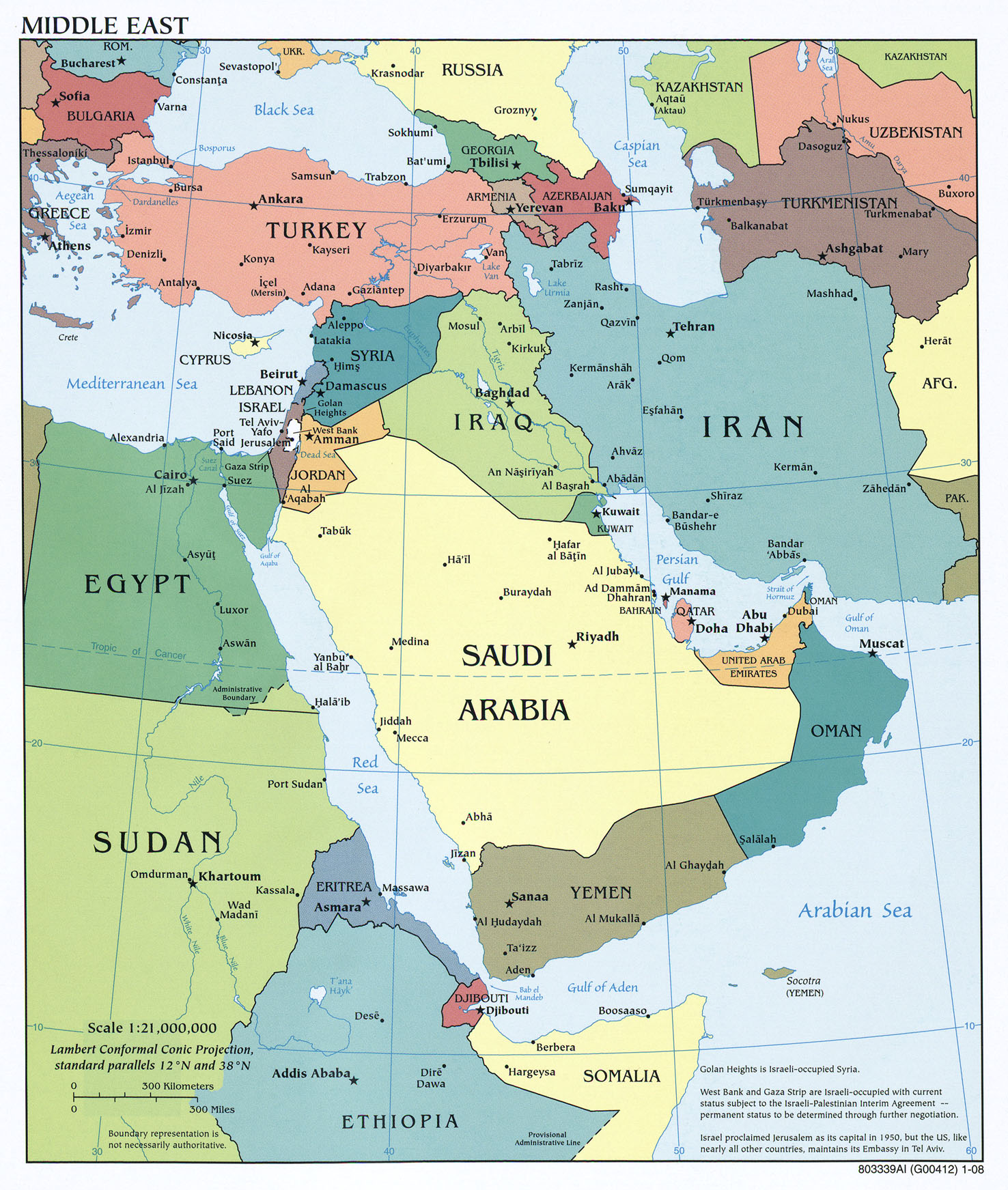
According to the U.S. Energy Information Administration (EIA) in 2010 before the civil war drove down oil production, Syria was the 34th largest oil producer in the world--behind Thailand, but just ahead of Vietnam. Syria's oil production of 367,100 barrels per day (bpd) represented about one half of one percent of world oil production--small in the overall picture. But it is more instructive to see what Syria's neighbors produce. (All oil production and ranking numbers are based on EIA figures for crude including lease condensate which is the definition oil.)

Oil producers in Syria's neighborhood ranked against all other countries in the world as of 2012 are as follows: Saudi Arabia (2nd, behind Russia), Iran (5th), Iraq (7th), Kuwait (8th), Egypt (25th), Turkey (54th), Israel (95th), and Jordan (96th). (In the age of jet warfare I am tempted to include the United Arab Emirates (8th) and Qatar (19th).) Turkey is more important than it seems because two major oil pipelines run through the country, one originating in Azerbiajan and the other originating in Iraq, that country's largest crude oil export line.

The general idea that Syria's neighbors hold the keys to a lot of oil certainly comes as little surprise to anyone with a cursory knowledge of the Middle East. But, the salient fact about the Syrian conflict is that it is a civil war. So, why is an American president so concerned about a war within the country?

That question leads to a second and even more salient fact. This civil war has now become a proxy for the Shia-Sunni split in the Muslim faith. Don't think: Catholics and Protestants in the United States. Rather think: Catholics and Protestants in Northern Ireland where a wide range of nonreligious issues sparked violence between the two groups for decades.

The split isn't just between countries that are predominantly Shia and predominately Sunni. It is, as Syria is showing, a split within many Arab nations which have citizens of both sects. So, there is not only the potential for conflict between nations in the Middle East, but also for the spread of civil unrest and civil war to other nations in the region. Iraq continues to demonstrate that this fear is not just hypothetical as bombings perpetrated in the name of minority Sunnis continue to vex a country which has experienced a long civil conflict between Shia and  Sunni after the U.S. invasion.

The spread of that kind of chaos would be very bad for oil supplies. Witness what has happened to Syrian oil production. It has fallen from 367,100 bpd in 2010 to just 157,200 bpd as of the end of last year. That's a decline of 57 percent in two years. That kind of decline in Middle East oil production would have catastrophic effects on an already iffy world economy, one absolutely dependent on oil for its smooth functioning.

The United States, as it turns out, has already been aiding the rebels for some time. The idea behind the aid may have been that the current regime might fall quickly, and the United States and its allies would have a solid relationship with those who take over.

With the stalemate continuing it's not obvious what strategy will work best to achieve America's number one goal in the region: stable oil production. One think tank academic even suggested that an ongoing stalemate was in America's best interests. Clearly, he doesn't believe the Shia-Sunni split will lead to conflict between or within other countries, at least on a scale that would prove troublesome.

But, there is one final consideration. After all we've been hearing about American energy independence, about growing domestic oil production, and about America being able to disengage from oil-exporting dictatorial regimes in the Middle East and elsewhere, the president seems as engaged as ever in the region.

There are three reasons for this: First, right now the United States imports just under half its oil needs. We produce a little over 7 million bpd and consume about 14 million bpd. Second, no realistic nonindustry assessment of future U.S. oil production suggests we'll stop needing substantial imports. Third, oil is traded in a world market, and its price is determined by world supply and demand. Any disruption in Middle Eastern oil supplies would lead to much higher prices which would ripple through the U.S. economy no matter how much we produce domestically.

The worldwide concern over Syria tells us that oil supplies remain tight and consuming nations remain very concerned about disruptions to supply. The oil price continues to hover near all-time highs when compared to the average daily price in 2011 and 2012, both record years. As the United States prepares plans for intervening militarily, there is not only much at stake in human terms, but also most assuredly in terms of critical oil supplies.

Kurt Cobb is an author, speaker, and columnist focusing on energy and the environment. He is a regular contributor to the Energy Voices section of The Christian Science Monitor and author of the peak-oil-themed novel Prelude. In addition, he has written columns for the Paris-based science news site Scitizen, and his work has been featured on Energy Bulletin (now Resilience.org), The Oil Drum, OilPrice.com, Econ Matters, Peak Oil Review, 321energy, Common Dreams, Le Monde Diplomatique and many other sites. He maintains a blog called Resource Insights and can be contacted at kurtcobb2001@yahoo.com.