As oil prices rose ever higher in the last decade, the optimists kept predicting rising production capacity and plummeting prices. Looks like they got it wrong. Read more.
Sunday, November 06, 2011
Time to worry: World oil production finishes six years of no growth
In lieu of my regular post I am linking to my latest column on Scitizen entitled "Time to Worry: World Oil Production Finishes Six Years of No Growth." Here is the teaser:


Sunday, October 30, 2011
Not so much: Shale gas shows its limitations
If you live in the United States and bother to turn on your television, it's almost impossible to avoid ads telling you that natural gas from shale is both abundant and environmentally safe to develop. In these ads, so many happy people seem to enjoy burning natural gas that it would be difficult to imagine that their smiles might come to a premature end.
Though the ads will probably not be withdrawn or recut, the emerging facts run counter to the gleeful tone of this television commercial produced by America's Natural Gas Alliance, a consortium of shale gas drillers. (For some more samples from other advertisers, click here, here and here.) First, it has become increasingly apparent from actual well data that shale gas is not being harvested according to the much-touted "manufacturing model." This model assumes that shale deposits are basically uniform, or at least uniform enough that a driller could sink a well virtually anywhere in a shale gas deposit and have an economical well blasting out methane.
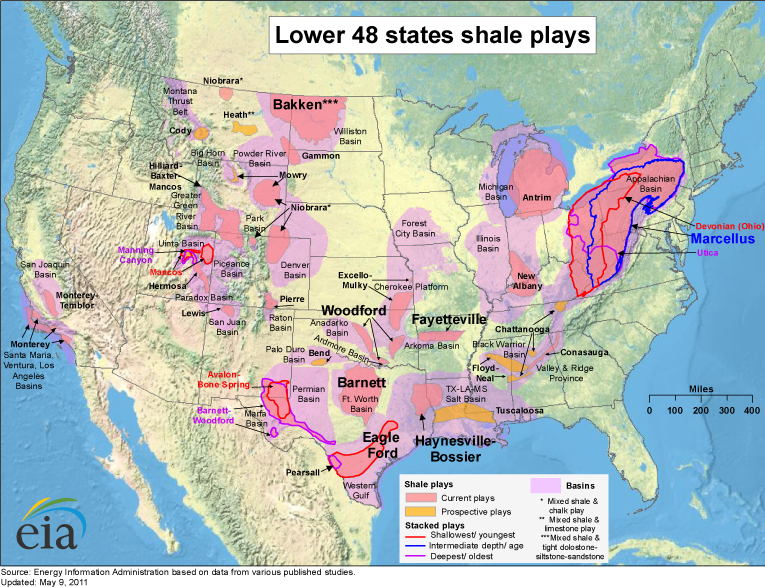
Independent petroleum geologist Art Berman and his colleague Lynn Pittinger, who studied the actual data, have shown that the manufacturing model is a myth, to wit: "The contraction of extensive geographic play regions into relatively small core areas greatly reduces the commercially recoverable reserves of the plays that we have studied." In short, you can't just drill anywhere. Drillers thought the huge plays highlighted in pink on the map below would yield profitable shale gas everywhere. It turns out that there are sweet spots, and then there are spots that are not sweet at all. And, the sweet spots are turning out to be quite small compared to the size of the deposits.
Though the ads will probably not be withdrawn or recut, the emerging facts run counter to the gleeful tone of this television commercial produced by America's Natural Gas Alliance, a consortium of shale gas drillers. (For some more samples from other advertisers, click here, here and here.) First, it has become increasingly apparent from actual well data that shale gas is not being harvested according to the much-touted "manufacturing model." This model assumes that shale deposits are basically uniform, or at least uniform enough that a driller could sink a well virtually anywhere in a shale gas deposit and have an economical well blasting out methane.
Independent petroleum geologist Art Berman and his colleague Lynn Pittinger, who studied the actual data, have shown that the manufacturing model is a myth, to wit: "The contraction of extensive geographic play regions into relatively small core areas greatly reduces the commercially recoverable reserves of the plays that we have studied." In short, you can't just drill anywhere. Drillers thought the huge plays highlighted in pink on the map below would yield profitable shale gas everywhere. It turns out that there are sweet spots, and then there are spots that are not sweet at all. And, the sweet spots are turning out to be quite small compared to the size of the deposits.
Berman and Pittinger also point out that initial high flow rates give out within a couple of years, putting drillers on a treadmill merely to replace this declining production and implying geometric increases in the number of wells they must drill to grow production consistently. What's more, the two authors question claims of decades-long flows, albeit at very low rates, from individual wells. The history of shale gas wells to date suggests that this is unlikely at best, and almost certainly uneconomical.
The second shoe to drop was a piece in The New York Times entitled "Insiders Sound an Alarm Amid a Natural Gas Rush" which cited internal memos and emails from industry and government officials admitting that estimates of the available gas from shale are overblown.
The third piece of damning news came from a recent U.S. Geological Survey (USGS) assessment of the Marcellus Shale natural gas deposits, by far the largest of their kind in the United States spanning vast areas of New York, Pennsylvania, and West Virginia as well as sections of Ohio, Kentucky and Tennessee. Previously, the U.S. Energy Information Administration, the statistical arm of the U.S. Department of Energy, had estimated that the Marcellus Shale contained 410 trillion cubic feet of so-called "technically recoverable shale gas resources." (This says nothing about whether such resources can be economically recovered. See the discussion of natural gas prices below.) The USGS report put the technically recoverable amount at 84 trillion cubic feet, an 80 percent reduction. For reference, the United States consumed about 24 trillion cubic feet of natural gas in 2010.
The often repeated claim that the United States has 100 years of natural gas at current rates of consumption is based to a considerable degree on the 410 trillion cubic feet which the Marcellus Shale supposedly added to U.S. resources. But, don't expect the shale gas drillers to stop advertising the 100 year claim anytime soon.
The fourth piece of news came not from industry insiders or studies of Mother Nature herself, but from state government. As I wrote earlier this year, new regulations could significantly dampen shale gas production. The newly released regulations in New York state do just that and to a degree that even I didn't think possible. Buffers are now required around water resources and have cut down the area available for drilling within existing shale gas leases by 40 and 60 percent. In addition, some municipalities are using their land use regulatory powers to make it all but impossible to drill in their jurisdictions.
As a result drillers are furious, so furious that some are thinking of abandoning their leases to concentrate on drilling in states with more lax regulations. New York may bid them a fond farewell since the legacy costs of cleaning up aquifers and drinking water could in the long run far outweigh the temporary economic gains from natural gas production.
Finally, there is always the question of price. A drilling foreman I know told me not too long ago that we might have quite a bit of natural gas available above $10 per thousand cubic feet, but not very much below $4. Price matters because the huge amount of natural gas promised by the industry would require the exploitation of deposits that are expensive to develop and therefore require prices much higher than today's.
I expect there to be a fifth, sixth and seventh piece of news and so on, detailing new limits on the rate of shale gas extraction. True, the explosive growth of shale gas production certainly caught many energy analysts by surprise. The received wisdom up until recently was that conventional gas production would decline, and the United States would increasingly rely on imports. But, I think the public and policymakers, who are being propagandized daily by the industry, may be in for yet another surprise.
Abundant natural gas? Sort of, but only if the price is right. Cheap natural gas for the long run? Not so much.
Sunday, October 23, 2011
Don't gamble with the grocery money
My grandfather loved to gamble. So, it is no surprise that my father likes to gamble. I confess that even I enjoy the occasional challenge of facing an opponent when both us have a little skin in the game. But my grandfather--who didn't always follow his own advice--gave my father some advice which he has taken seriously and passed on to me, to wit: Don't gamble with the grocery money.
It sounds simple enough. But the real trick is to figure out whether you are gambling with the grocery money. I began thinking about all this as I was seated next to a woman retiree on a train ride during a recent trip. We got to talking about the Occupy Wall Street protest, and we went on from there to talk about the stock market and retirement savings. I suggested to her that the retirement savings of the entire middle class of America are at grave risk. I explained that the seeds of that risk were sown back in the early 1980s when a then little-known provision of the tax code labeled 401k--which was designed to encourage supplementary retirement savings--was used to transfer all the risk of pensions from companies to employees.
Before the 401k craze (403b for nonprofits) companies with pension plans generally guaranteed a specific benefit, i.e., an amount per month that would be paid to retirees for life based on years of service, pay level and sometimes other factors. It was up to the company to figure out how to make that happen with money set aside usually through both employer and employee contributions. The company often hired outside money managers to invest the money based on the projected needs of retirees. Such plans are usually referred to as defined benefit plans, and they were the norm before the 401k. Now, they are rare.
The result has been that every person with a 401k has had to become an amateur investor. And, all seemed well from the early 1980s onward when such plans first came into widespread use. The world had just embarked on what would turn out to be the biggest bull market in stocks ever seen. As John Kenneth Galbraith once said, "Financial genius is a rising stock market." It became common wisdom that everyone should own "stocks for the long run." We were told we were in a "new era" of unprecedented technological progress. We were also told that monetary authorities had now mastered the business cycle through their clever manipulation of interest rates and other levers of finance.
(It is puzzling why anyone would continue to assign omniscience and omnipotence to central banks and governments after the Bear Stearns collapse, the 2008 crash, phase one of the European debt crisis last year, and now phase two of the European debt crisis. If central banks and governments are so powerful and all-knowing, shouldn't they have been able to prevent these serial financial implosions?)
Back to the poor woman sitting next to me on the train. I suggested that faith in the narrative described above was borne of a highly unusual period of history, and that one has only to go back to The Great Depression to find that it is possible for the stock market to decline 80 percent and not recover to its old highs for two and half decades. (I forgot to mention that today Japan's stock market is down more than 75 percent from the high it reached in 1989!) I suggested that the current system of retirement finance was largely concocted to relieve corporations and other institutions of their retirement obligations to employees and to enrich Wall Street. Wall Street, after all, gets its fees whether the client makes money or not.
I proffered that the game was a dangerous one for all but the largest players. Why? Three reasons: First, those players have access to information, connections and great gobs of capital that can move markets, and they are perfectly capable of making money when markets go down as well as up. Second, they have so much money that even severe losses will not prevent them from buying groceries and paying their mortgages and utility bills. Third, the government will step in to prevent them from going bust if it believes this means preventing a systemwide financial meltdown.
Were average people like her really in a position to compete with that? I asked. I thought to myself that this woman and so many like her are not playing with money they can afford to lose. They are gambling with the grocery money and they don't even know it! And, that's because they've been sold the idea that they are investing which sounds a lot nicer than gambling. But it amounts to the same thing.
Of course, if everyone took my advice tomorrow, the stock market would collapse. But my argument is that we should have never have gotten to this point. We should never have abandoned a system that makes retirees essentially indifferent to the level of the stock market. But because of the move to 401ks, many are now risking losing their grocery money and do not seem to know it.
Perhaps my fears are unfounded. But as I look at the amount of gray hair in the crowds at various Occupy Wall Street events, I wonder if a lot of damage hasn't already been done. The last 10 years have netted the average investor essentially nothing. And, the most recent market swoon has once again tested hopes that the casino profits in the market can continue.
With the Europeans outdoing the Keystone Cops as they slide toward an ineluctable default in Greece and a possible worldwide contagion; with a worldwide economic slowdown and possibly a recession already underway; with rumors arising nearly every day that one bank or another may soon go down; and with a severe property bust already evident in China, I fear there is worse to come.
It sounds simple enough. But the real trick is to figure out whether you are gambling with the grocery money. I began thinking about all this as I was seated next to a woman retiree on a train ride during a recent trip. We got to talking about the Occupy Wall Street protest, and we went on from there to talk about the stock market and retirement savings. I suggested to her that the retirement savings of the entire middle class of America are at grave risk. I explained that the seeds of that risk were sown back in the early 1980s when a then little-known provision of the tax code labeled 401k--which was designed to encourage supplementary retirement savings--was used to transfer all the risk of pensions from companies to employees.
Before the 401k craze (403b for nonprofits) companies with pension plans generally guaranteed a specific benefit, i.e., an amount per month that would be paid to retirees for life based on years of service, pay level and sometimes other factors. It was up to the company to figure out how to make that happen with money set aside usually through both employer and employee contributions. The company often hired outside money managers to invest the money based on the projected needs of retirees. Such plans are usually referred to as defined benefit plans, and they were the norm before the 401k. Now, they are rare.
The result has been that every person with a 401k has had to become an amateur investor. And, all seemed well from the early 1980s onward when such plans first came into widespread use. The world had just embarked on what would turn out to be the biggest bull market in stocks ever seen. As John Kenneth Galbraith once said, "Financial genius is a rising stock market." It became common wisdom that everyone should own "stocks for the long run." We were told we were in a "new era" of unprecedented technological progress. We were also told that monetary authorities had now mastered the business cycle through their clever manipulation of interest rates and other levers of finance.
(It is puzzling why anyone would continue to assign omniscience and omnipotence to central banks and governments after the Bear Stearns collapse, the 2008 crash, phase one of the European debt crisis last year, and now phase two of the European debt crisis. If central banks and governments are so powerful and all-knowing, shouldn't they have been able to prevent these serial financial implosions?)
Back to the poor woman sitting next to me on the train. I suggested that faith in the narrative described above was borne of a highly unusual period of history, and that one has only to go back to The Great Depression to find that it is possible for the stock market to decline 80 percent and not recover to its old highs for two and half decades. (I forgot to mention that today Japan's stock market is down more than 75 percent from the high it reached in 1989!) I suggested that the current system of retirement finance was largely concocted to relieve corporations and other institutions of their retirement obligations to employees and to enrich Wall Street. Wall Street, after all, gets its fees whether the client makes money or not.
I proffered that the game was a dangerous one for all but the largest players. Why? Three reasons: First, those players have access to information, connections and great gobs of capital that can move markets, and they are perfectly capable of making money when markets go down as well as up. Second, they have so much money that even severe losses will not prevent them from buying groceries and paying their mortgages and utility bills. Third, the government will step in to prevent them from going bust if it believes this means preventing a systemwide financial meltdown.
Were average people like her really in a position to compete with that? I asked. I thought to myself that this woman and so many like her are not playing with money they can afford to lose. They are gambling with the grocery money and they don't even know it! And, that's because they've been sold the idea that they are investing which sounds a lot nicer than gambling. But it amounts to the same thing.
Of course, if everyone took my advice tomorrow, the stock market would collapse. But my argument is that we should have never have gotten to this point. We should never have abandoned a system that makes retirees essentially indifferent to the level of the stock market. But because of the move to 401ks, many are now risking losing their grocery money and do not seem to know it.
Perhaps my fears are unfounded. But as I look at the amount of gray hair in the crowds at various Occupy Wall Street events, I wonder if a lot of damage hasn't already been done. The last 10 years have netted the average investor essentially nothing. And, the most recent market swoon has once again tested hopes that the casino profits in the market can continue.
With the Europeans outdoing the Keystone Cops as they slide toward an ineluctable default in Greece and a possible worldwide contagion; with a worldwide economic slowdown and possibly a recession already underway; with rumors arising nearly every day that one bank or another may soon go down; and with a severe property bust already evident in China, I fear there is worse to come.
Sunday, October 16, 2011
Can Margaret Atwood's environmental message reach a broad public?
Okay. So you want to reach the broad public about the multiple, intertwining, galloping climate, resource, and environmental disasters facing every living creature on Earth. Do you write up a detailed, compact analysis of the problem and make it available on the Internet? Should you put it all into a documentary film to make it more accessible? Maybe you should write a companion book as well for the few remaining readers willing to pay for an actual physical copy of something.
All of that has been done, of course. And, it would be unfair to say that it has had no effect. There is now a markedly larger group of people in the world who are conversant about all the major climate, resource and environmental problems we face. There are even many more politicians and policymakers who've been educated in this way. But instead of the swift, decisive action one might expect to address these onrushing catastrophes-in-the-making, the response--when there has been any at all--has been rather tepid.
One reason is that politicians by their very nature are inclined to do only what the public will let them do. (Naturally, they'll often do things which are not in the interest of the broad public if that public is unaware of what the politicians are doing.) But when it comes to complex, knotty issues such as climate change and peak oil, there is no wealthy constituency which can arrange midnight deals out of view of public scrutiny. That means there must be public pressure intense enough to motivate politicians to act. It has to be so intense that they think they might lose an election over such issues.
Perhaps there is another avenue of public persuasion that is up to this task. We need a compelling narrative, I often hear. So true. But what makes a narrative compelling? Certainly, it must be simple enough to be understood by a broad group of people. Check. And, it must play on values that people already hold dear. Check. Finally, it must be in a form that is readily acceptable and easily obtained by the target audience. Check.
Now, the problem, of course, in that a compelling narrative about our climate, resource and environmental challenges would be hard to make simple. The whole point would be to make it clear that these are complex problems with no easy solutions. And, the whole point would be make it clear that these problems arise from the totality of the way we live, making it difficult to appeal to existing values. And, the whole point would be to startle people into a mode of awareness that goes beyond their current way of seeing.
In The Year of the Flood Margaret Atwood attempts such a narrative in an almost fairytale fashion. The clever thing about the novel is that it appears to be a typical post-apocalyptic story, taking us to an indeterminate locale in the future in which two young female characters find themselves caught in the great "waterless" flood, a plague that is devastating the population. But we quickly move back in time. We follow these characters as they work and wander in this pre-plague futuristic world, one that seems dysfunctional and violent in ways that are familiar to us today. So far, it's pretty standard science fiction stuff.
But then the two women end up joining the friendly Gardeners' cult whose members are so gentle and wise that one is lulled into thinking that Fred Rogers might suddenly appear at the edge of their rooftop garden, eager to take his television viewers on a tour. The impression that some of the Gardeners might have been descended from the Amish seems well-founded. How quaint they are in this world of advanced genetic technology.
Gradually readers are pulled into a sinister world controlled by private security firms which now run the police force and the prisons and which also guard corporation employees who live in isolated compounds. The corporations have become ascendant and their technological vision of the world knows no constraints. This is because a badly run authoritarian, corporation-dominated state has replaced all other civil authority. Everyone must have a state-sanctioned identity, and deviations from the corporate line, i.e., all technology is good for us and corporate control brings prosperity and health, can mean loss of a job and even prison time.
The science fiction fantasy elements of the story actually comport well with the expectations of modern readers. So, in this respect Atwood has managed to overcome possible resistance to her narrative. The religious views of the Gardeners' cult are summarized in occasional addresses by the leader of the group, Adam One. (Only in a society completely hooked on genetically engineered food would people who grow food in a garden be considered a cult.) The religious discussion makes it possible in some ways to bypass the modern industrial mind and reinitiate contact with the natural world using religious metaphors from agriculture and nature. And, this makes it possible to explore values that readers might harbor apart from the industrial corporate world.
For all these reasons I believe Atwood has produced a master work of environmental awareness. This novel, which appears to be merely the fantasy of a talented Canadian author is, in fact, meticulously researched. Its references to genetic engineering are not merely fanciful but anchored in actual ongoing scientific work. The story exaggerates for effect, of course. But its dissection of the food system (one main character works briefly for a fast food chain called SecretBurgers) is clearly drawn from a keen understanding of our current system. The privatization of every public function seems overblown, but suggests the logical extreme of our current trajectory.
A well-designed narrative enters the mind at both the conscious and unconscious levels. I am reminded of the film Avatar which, though a piece of science fiction, is essentially a story about the displacement of indigenous people by a ruthless corporation to enable the mining of a valuable mineral. Right-wing pundits decried the film as an attack on American foreign policy which they said has historically helped to spread democracy and prosperity. No matter. Moviegoers liked the film as much in Alabama and Mississippi as they did in California and New York. Whether the film changed mindsets is unknowable. But it had no trouble gaining acceptance.
Atwood's novel is not a movie, not yet anyway. And, so even its well-founded success will still result in only limited influence. After all, one must buy it. For most people that will cost quite a bit more than a movie ticket. And, then one must devote many hours to reading its 400 plus pages. But The Year of the Flood does offer an interesting blueprint for the successful environmental/resource/climate-change story. And, for that reason it would behoove all those who are searching for ways to reach the broader public about these important issues to read this remarkable work.
All of that has been done, of course. And, it would be unfair to say that it has had no effect. There is now a markedly larger group of people in the world who are conversant about all the major climate, resource and environmental problems we face. There are even many more politicians and policymakers who've been educated in this way. But instead of the swift, decisive action one might expect to address these onrushing catastrophes-in-the-making, the response--when there has been any at all--has been rather tepid.
One reason is that politicians by their very nature are inclined to do only what the public will let them do. (Naturally, they'll often do things which are not in the interest of the broad public if that public is unaware of what the politicians are doing.) But when it comes to complex, knotty issues such as climate change and peak oil, there is no wealthy constituency which can arrange midnight deals out of view of public scrutiny. That means there must be public pressure intense enough to motivate politicians to act. It has to be so intense that they think they might lose an election over such issues.
Perhaps there is another avenue of public persuasion that is up to this task. We need a compelling narrative, I often hear. So true. But what makes a narrative compelling? Certainly, it must be simple enough to be understood by a broad group of people. Check. And, it must play on values that people already hold dear. Check. Finally, it must be in a form that is readily acceptable and easily obtained by the target audience. Check.
Now, the problem, of course, in that a compelling narrative about our climate, resource and environmental challenges would be hard to make simple. The whole point would be to make it clear that these are complex problems with no easy solutions. And, the whole point would be make it clear that these problems arise from the totality of the way we live, making it difficult to appeal to existing values. And, the whole point would be to startle people into a mode of awareness that goes beyond their current way of seeing.
In The Year of the Flood Margaret Atwood attempts such a narrative in an almost fairytale fashion. The clever thing about the novel is that it appears to be a typical post-apocalyptic story, taking us to an indeterminate locale in the future in which two young female characters find themselves caught in the great "waterless" flood, a plague that is devastating the population. But we quickly move back in time. We follow these characters as they work and wander in this pre-plague futuristic world, one that seems dysfunctional and violent in ways that are familiar to us today. So far, it's pretty standard science fiction stuff.
But then the two women end up joining the friendly Gardeners' cult whose members are so gentle and wise that one is lulled into thinking that Fred Rogers might suddenly appear at the edge of their rooftop garden, eager to take his television viewers on a tour. The impression that some of the Gardeners might have been descended from the Amish seems well-founded. How quaint they are in this world of advanced genetic technology.
Gradually readers are pulled into a sinister world controlled by private security firms which now run the police force and the prisons and which also guard corporation employees who live in isolated compounds. The corporations have become ascendant and their technological vision of the world knows no constraints. This is because a badly run authoritarian, corporation-dominated state has replaced all other civil authority. Everyone must have a state-sanctioned identity, and deviations from the corporate line, i.e., all technology is good for us and corporate control brings prosperity and health, can mean loss of a job and even prison time.
The science fiction fantasy elements of the story actually comport well with the expectations of modern readers. So, in this respect Atwood has managed to overcome possible resistance to her narrative. The religious views of the Gardeners' cult are summarized in occasional addresses by the leader of the group, Adam One. (Only in a society completely hooked on genetically engineered food would people who grow food in a garden be considered a cult.) The religious discussion makes it possible in some ways to bypass the modern industrial mind and reinitiate contact with the natural world using religious metaphors from agriculture and nature. And, this makes it possible to explore values that readers might harbor apart from the industrial corporate world.
For all these reasons I believe Atwood has produced a master work of environmental awareness. This novel, which appears to be merely the fantasy of a talented Canadian author is, in fact, meticulously researched. Its references to genetic engineering are not merely fanciful but anchored in actual ongoing scientific work. The story exaggerates for effect, of course. But its dissection of the food system (one main character works briefly for a fast food chain called SecretBurgers) is clearly drawn from a keen understanding of our current system. The privatization of every public function seems overblown, but suggests the logical extreme of our current trajectory.
A well-designed narrative enters the mind at both the conscious and unconscious levels. I am reminded of the film Avatar which, though a piece of science fiction, is essentially a story about the displacement of indigenous people by a ruthless corporation to enable the mining of a valuable mineral. Right-wing pundits decried the film as an attack on American foreign policy which they said has historically helped to spread democracy and prosperity. No matter. Moviegoers liked the film as much in Alabama and Mississippi as they did in California and New York. Whether the film changed mindsets is unknowable. But it had no trouble gaining acceptance.
Atwood's novel is not a movie, not yet anyway. And, so even its well-founded success will still result in only limited influence. After all, one must buy it. For most people that will cost quite a bit more than a movie ticket. And, then one must devote many hours to reading its 400 plus pages. But The Year of the Flood does offer an interesting blueprint for the successful environmental/resource/climate-change story. And, for that reason it would behoove all those who are searching for ways to reach the broader public about these important issues to read this remarkable work.
Sunday, October 09, 2011
Destroying dreams the peak oil way
It is with some trepidation that I prepare for a trip that includes an appearance before college students who generally find the idea of peak oil so disturbing that they do not want to even hear about it. And, I can't blame them. They must think that I have come to destroy their dreams, dreams premised on a future of ever expanding material prosperity and career advancement.
Certainly, a persistent, irreversible decline in world oil production would reshape nearly every facet of our lives. I like to think that we don't need to give up on our dreams, just choose different ones that are achievable in the challenging environment we are likely to encounter as the coming decades unfold. And, I like to think that those dreams can be as much, if not more, satisfying than our current ones.
That's cold comfort to those whose entire education is designed to prepare them for exceedingly narrow occupational niches, niches which they've been told will bring them wealth and security. It is an unfortunate truth that in a world climbing down from unsustainable complexity (fostered by previously cheap energy supplies), many of those niches will disappear.
I've come to understand that most people cannot imagine a future that is different from the recent past--and by that I mean the past few decades. And, this tells me that until the past few decades are a fading memory, most people will find imagining an entirely different future an insuperable task. Even as conditions worsen, they will assume that if governments will just take the right steps, then the world will return to its former path of exponential growth and unlimited opportunity. They will assume this because opposition parties will tell them so just to get elected.
As the world's financial markets gyrate wildly, I find myself in conversations that touch on investing with both family and friends. With family members I am much more forthright about how I perceive the risks we face. I know that my family members will forgive my brash interventions into their lives and that, in any case, they are all strong enough to ignore me and think for themselves. But with friends I am reluctant to speak about such matters and only discuss them when others introduce the topic. If I am asked for my opinion, I currently urge extreme caution. (Full disclosure: I exercise exactly two levels of care in investing: caution and extreme caution.)
The response more often than not is that, while stocks are down, they always go back up, and so naturally, it's not smart to sell your stocks when they're down. This sounds suspiciously like the person who is losing at roulette and sticks around in hopes of winning her money back. It's hard to counter people's recent experience, i.e., the last three decades which delivered the greatest bull market of all time in stocks. And, it's even harder to convince them that history is replete with examples of stocks falling to a rather small fraction of their highs under conditions very similar to those which prevail today. Japan--whose market is down more than 75 percent since 1989--comes to mind.
But I now realize that there is a dynamic here similar to that which I experience with college students. Middle-aged people with retirement savings have dreams, too. And, my suggestion to exercise extreme caution, i.e., get out of the stock market and into cash, is tantamount to telling them that they cannot have their dreams. So many who have saved for retirement by investing in the casino called the stock market believe that said stock market will provide the money to pay for dreams their regular salaries could never have financed.
This dynamic, unfortunately, is yet another roadblock hindering people from taking steps to salvage what future they can. Would-be destroyers of dreams, beware! You will have the ear of fewer and fewer people over time as many tune you out in order to preserve the image of the future they have in mind.
Of course, I could be wrong in my views and miss out on participating in and getting rich from a great economic boom ahead that will inevitably come after our leaders clear away the few small hindrances that remain. But then I'm not sure I really want what that path has to offer, even if it turns out to be available. In that sense, I'm covered for both positive and negative outcomes since our present arrangements, economic, social, political and occupational, seem less and less alluring with each passing day. Maybe that's the key to giving up on the dreams we've been taught to dream and dreaming something altogether new.
Certainly, a persistent, irreversible decline in world oil production would reshape nearly every facet of our lives. I like to think that we don't need to give up on our dreams, just choose different ones that are achievable in the challenging environment we are likely to encounter as the coming decades unfold. And, I like to think that those dreams can be as much, if not more, satisfying than our current ones.
That's cold comfort to those whose entire education is designed to prepare them for exceedingly narrow occupational niches, niches which they've been told will bring them wealth and security. It is an unfortunate truth that in a world climbing down from unsustainable complexity (fostered by previously cheap energy supplies), many of those niches will disappear.
I've come to understand that most people cannot imagine a future that is different from the recent past--and by that I mean the past few decades. And, this tells me that until the past few decades are a fading memory, most people will find imagining an entirely different future an insuperable task. Even as conditions worsen, they will assume that if governments will just take the right steps, then the world will return to its former path of exponential growth and unlimited opportunity. They will assume this because opposition parties will tell them so just to get elected.
As the world's financial markets gyrate wildly, I find myself in conversations that touch on investing with both family and friends. With family members I am much more forthright about how I perceive the risks we face. I know that my family members will forgive my brash interventions into their lives and that, in any case, they are all strong enough to ignore me and think for themselves. But with friends I am reluctant to speak about such matters and only discuss them when others introduce the topic. If I am asked for my opinion, I currently urge extreme caution. (Full disclosure: I exercise exactly two levels of care in investing: caution and extreme caution.)
The response more often than not is that, while stocks are down, they always go back up, and so naturally, it's not smart to sell your stocks when they're down. This sounds suspiciously like the person who is losing at roulette and sticks around in hopes of winning her money back. It's hard to counter people's recent experience, i.e., the last three decades which delivered the greatest bull market of all time in stocks. And, it's even harder to convince them that history is replete with examples of stocks falling to a rather small fraction of their highs under conditions very similar to those which prevail today. Japan--whose market is down more than 75 percent since 1989--comes to mind.
But I now realize that there is a dynamic here similar to that which I experience with college students. Middle-aged people with retirement savings have dreams, too. And, my suggestion to exercise extreme caution, i.e., get out of the stock market and into cash, is tantamount to telling them that they cannot have their dreams. So many who have saved for retirement by investing in the casino called the stock market believe that said stock market will provide the money to pay for dreams their regular salaries could never have financed.
This dynamic, unfortunately, is yet another roadblock hindering people from taking steps to salvage what future they can. Would-be destroyers of dreams, beware! You will have the ear of fewer and fewer people over time as many tune you out in order to preserve the image of the future they have in mind.
Of course, I could be wrong in my views and miss out on participating in and getting rich from a great economic boom ahead that will inevitably come after our leaders clear away the few small hindrances that remain. But then I'm not sure I really want what that path has to offer, even if it turns out to be available. In that sense, I'm covered for both positive and negative outcomes since our present arrangements, economic, social, political and occupational, seem less and less alluring with each passing day. Maybe that's the key to giving up on the dreams we've been taught to dream and dreaming something altogether new.
Sunday, October 02, 2011
Crisscrossing the Rubicon of peak oil
In the minds of many of those concerned about an imminent rendezvous with peak oil, the day the world slides past the all-time peak in oil production will be a fateful and irreversible crossing. After it all the calamitous predicted consequences of the ensuing decline will become obvious--financial collapse, unaffordable energy prices, shortages of food and other goods dependent on cheap oil, and mounting unemployment to name a few. And, the cause of these effects will be plain for everyone to see.
But even as some of these symptoms begin to manifest themselves, the public remains ignorant that stringency in oil supplies lies at the heart of them (though peak oil is admittedly part of a complex web of problems related to our broader energy and resource use). Why is this so?
From the long view the level of oil production on a graph in this decade may well look like a peak. But from closer in, as we experience it day to day, month to month, and year to year, production may seem to be on a long, bumpy plateau. Even though one of the world's major sources of energy information, the International Energy Agency, admits that conventional crude oil probably peaked in 2006, the public and most policymakers remain ignorant of this sign that liquid fuels will have a hard time keeping up with demand.
It is true that other liquids--natural gas liquids, biofuels and unconventional oil derivatives--have allowed total liquid fuels production to eek out at new all-time high this year. But robust demand once again drove the price for Brent crude above $100 where it remains as of this writing. This seems to have had the effect of dampening economic activity and so prices and production have actually fallen from their highest levels as demand has waned. We know that oil price spikes have been associated with 10 of the last 11 economic recessions (PDF); there is reason to believe that we are headed into number 12.
It is this pattern which prevents a clear signal to people, policymakers and markets about our predicament. We seemed to be crossing the Rubicon of peak oil in 2008 as prices rose to $147 a barrel only to cross back during the subsequent two and a half years leading to a new nominal peak in production in January this year. In between the price of oil plummeted to around $35 a barrel before rebounding above $100.
This phenomenon has now been described for us by the former editor of Petroleum Review, Chris Skrebowski, in his piece "A Brief Economic Explanation of Peak Oil." Skrebowski believes there is a sort of speed limit that oil prices are imposing on the economy, and it begins roughly when oil trades above $90 a barrel though the number may be higher for high-growth countries such as China, perhaps up to $110. If prices stay in this area for long, it appears to signal that a recession is not far away.
From the public's point of view, oil prices this high have become a "normal" part of life. And, if Skrebowski's analysis proves correct, there will be no dramatic price spikes above, say, $200 a barrel that stick, something that might definitively signal the beginning of a long-term oil crisis in the public's mind. Instead, there will be repeated attempts to revive economic activity through fiscal and monetary stimulus which will ultimately fail to gain traction as oil prices shoot up once again, dampen economic activity and lead to recession after recession. During each recession oil prices will drop making the peak oil problem seem to disappear.
It's certainly true that significant increases in world production of liquid fuels would end this cycle. But as Skrebowski points out, "If adaptive responses were fast enough and large enough, oil prices might be broadly stable. They clearly are not." By "adaptive responses" he means in part those increases in oil production and the production of substitutes. But, the unstable economic climate we are now facing is making long-term planning and investment in both the oil industry and the alternative energy industries difficult.
What Skrebowski offers is a sound rejoinder to those economists who say that peak oil theorists don't take into account economic factors--factors which those economists say will solve the problem of peak oil whenever it arrives by destroying demand and making substitutes profitable. For now, however, we can see that the economic factors are not really solving the problem of peak oil, but possibly feeding it. That's not something most economists will be able to hear. And, it describes a pattern that will likely only confuse the public and policymakers even though Skrebowski has explained it in terms that any thoughtful person can understand--if only they want to.
But even as some of these symptoms begin to manifest themselves, the public remains ignorant that stringency in oil supplies lies at the heart of them (though peak oil is admittedly part of a complex web of problems related to our broader energy and resource use). Why is this so?
From the long view the level of oil production on a graph in this decade may well look like a peak. But from closer in, as we experience it day to day, month to month, and year to year, production may seem to be on a long, bumpy plateau. Even though one of the world's major sources of energy information, the International Energy Agency, admits that conventional crude oil probably peaked in 2006, the public and most policymakers remain ignorant of this sign that liquid fuels will have a hard time keeping up with demand.
It is true that other liquids--natural gas liquids, biofuels and unconventional oil derivatives--have allowed total liquid fuels production to eek out at new all-time high this year. But robust demand once again drove the price for Brent crude above $100 where it remains as of this writing. This seems to have had the effect of dampening economic activity and so prices and production have actually fallen from their highest levels as demand has waned. We know that oil price spikes have been associated with 10 of the last 11 economic recessions (PDF); there is reason to believe that we are headed into number 12.
It is this pattern which prevents a clear signal to people, policymakers and markets about our predicament. We seemed to be crossing the Rubicon of peak oil in 2008 as prices rose to $147 a barrel only to cross back during the subsequent two and a half years leading to a new nominal peak in production in January this year. In between the price of oil plummeted to around $35 a barrel before rebounding above $100.
This phenomenon has now been described for us by the former editor of Petroleum Review, Chris Skrebowski, in his piece "A Brief Economic Explanation of Peak Oil." Skrebowski believes there is a sort of speed limit that oil prices are imposing on the economy, and it begins roughly when oil trades above $90 a barrel though the number may be higher for high-growth countries such as China, perhaps up to $110. If prices stay in this area for long, it appears to signal that a recession is not far away.
From the public's point of view, oil prices this high have become a "normal" part of life. And, if Skrebowski's analysis proves correct, there will be no dramatic price spikes above, say, $200 a barrel that stick, something that might definitively signal the beginning of a long-term oil crisis in the public's mind. Instead, there will be repeated attempts to revive economic activity through fiscal and monetary stimulus which will ultimately fail to gain traction as oil prices shoot up once again, dampen economic activity and lead to recession after recession. During each recession oil prices will drop making the peak oil problem seem to disappear.
It's certainly true that significant increases in world production of liquid fuels would end this cycle. But as Skrebowski points out, "If adaptive responses were fast enough and large enough, oil prices might be broadly stable. They clearly are not." By "adaptive responses" he means in part those increases in oil production and the production of substitutes. But, the unstable economic climate we are now facing is making long-term planning and investment in both the oil industry and the alternative energy industries difficult.
What Skrebowski offers is a sound rejoinder to those economists who say that peak oil theorists don't take into account economic factors--factors which those economists say will solve the problem of peak oil whenever it arrives by destroying demand and making substitutes profitable. For now, however, we can see that the economic factors are not really solving the problem of peak oil, but possibly feeding it. That's not something most economists will be able to hear. And, it describes a pattern that will likely only confuse the public and policymakers even though Skrebowski has explained it in terms that any thoughtful person can understand--if only they want to.
Sunday, September 25, 2011
Ignoring Daniel Yergin
It would be hard for the average person to understand why the vague ramblings of the world's foremost energy cornucopian, the sweet, smiling, even-tempered Daniel Yergin, could stir up so much antipathy. The typical inhabitant of planet Earth has never even heard of this man and remains blissfully unaware of the dangers of fossil fuel depletion--dangers that Yergin naturally dismisses in his recent piece in The Wall Street Journal.
But back in the rarified realm of the energy-obsessed we find two responses posted under the headline: "Daniel Yergin - Oil Company Whore." I was expecting some red meat. But the worst that either of the writers of these responses could muster is that Yergin is a "Pulitzer Prize-winning historian" and not particularly well-qualified to assess future oil supplies. In the comments under these pieces (all rebuttals), one commenter calls Yergin "the Alan Greenspan of the oil industry--the guy everyone thinks is a genius...until he is proved disastrously wrong." It's an unflattering comparison, but only to those who understand both who Alan Greenspan is and the complex reasoning behind the charge that he is the architect of our current economic troubles.
In truth, upon reading Yergin's latest missive to the world's policy elite, I found myself utterly bored. Could this man ever say something that would upset anyone other than a small group of activists who are extremely worried about oil supplies peaking before the end of this decade? I doubt it. He is paid to soothe, and these days so soothing is his writing that it should be placed next to the Sominex on the drugstore shelf.
Certainly, those concerned about how policymakers think about our energy future will feel compelled to respond to this craftily written piece and to Yergin's newest book--a continuation of his famous history of oil, The Prize, but with a broader focus. Even if the respondents succeed at denting the minds of policymakers, what can they achieve? Wherever the peak oil movement plays at the inside game, it will be at a disadvantage. It is far easier to throw sand in the gears of a representative democracy than it is to get anything done. And, it is far more difficult to get people to prepare for a challenging future of energy stringency than it is to convince them that the future of energy should be entrusted to upbeat experts in suits.
I write all of this to lay out briefly the arena in which this battle of ideas is joined. It is an arena chosen by Daniel Yergin in which he has many preponderant advantages. He may be a Pulitzer Prize-winning historian with no formal geological training, but he's also the head honcho of the world's most recognized brand in energy advice, Cambridge Energy Research Associates (now absorbed by IHS). He is a frequent face at Congressional hearings and a man who hobnobs with kings and prime ministers the whole world wide. It is hard to convince anyone at the top levels that he doesn't know what he's talking about, especially when the world's major newspapers and broadcast venues give him access usually reserved for high government officials.
No matter how well-reasoned one's arguments are, as a tactical matter, a head-to-head confrontation in the media with Yergin will be a draw at best, but more likely a loss since reason is not what moves crowds. I agree that the fact that Yergin must now address peak oil explicitly and at length shows that he is actually on the defensive. Before, say, 2005 he wouldn't have bothered even to mention it. This shows some progress, but not among those who matter most.
There is a vast audience of people out there who, as I said, have never heard of Daniel Yergin, and who have never even heard the words "peak oil." The elected officials who guide our policy will do little to address peak oil and related issues until voters communicate that these are top priorities that will affect elections. Beyond this there is the issue of encouraging personal preparedness, something that is in large part outside the scope of government policy.
I was involved in discussions about how to respond to Yergin's long tirade against the peak oil movement. Should the response be point-by-point, or should we just make our case the way we want to? Whether it's the inside game or a more extensive public education strategy, the answer should be obvious. We should largely ignore Daniel Yergin and find better ways to convey not just the facts about energy, but also model an appropriate emotional counterpoint that will penetrate hearts and minds in ways that Yergin's sleep-inducing message never will.
But back in the rarified realm of the energy-obsessed we find two responses posted under the headline: "Daniel Yergin - Oil Company Whore." I was expecting some red meat. But the worst that either of the writers of these responses could muster is that Yergin is a "Pulitzer Prize-winning historian" and not particularly well-qualified to assess future oil supplies. In the comments under these pieces (all rebuttals), one commenter calls Yergin "the Alan Greenspan of the oil industry--the guy everyone thinks is a genius...until he is proved disastrously wrong." It's an unflattering comparison, but only to those who understand both who Alan Greenspan is and the complex reasoning behind the charge that he is the architect of our current economic troubles.
In truth, upon reading Yergin's latest missive to the world's policy elite, I found myself utterly bored. Could this man ever say something that would upset anyone other than a small group of activists who are extremely worried about oil supplies peaking before the end of this decade? I doubt it. He is paid to soothe, and these days so soothing is his writing that it should be placed next to the Sominex on the drugstore shelf.
Certainly, those concerned about how policymakers think about our energy future will feel compelled to respond to this craftily written piece and to Yergin's newest book--a continuation of his famous history of oil, The Prize, but with a broader focus. Even if the respondents succeed at denting the minds of policymakers, what can they achieve? Wherever the peak oil movement plays at the inside game, it will be at a disadvantage. It is far easier to throw sand in the gears of a representative democracy than it is to get anything done. And, it is far more difficult to get people to prepare for a challenging future of energy stringency than it is to convince them that the future of energy should be entrusted to upbeat experts in suits.
I write all of this to lay out briefly the arena in which this battle of ideas is joined. It is an arena chosen by Daniel Yergin in which he has many preponderant advantages. He may be a Pulitzer Prize-winning historian with no formal geological training, but he's also the head honcho of the world's most recognized brand in energy advice, Cambridge Energy Research Associates (now absorbed by IHS). He is a frequent face at Congressional hearings and a man who hobnobs with kings and prime ministers the whole world wide. It is hard to convince anyone at the top levels that he doesn't know what he's talking about, especially when the world's major newspapers and broadcast venues give him access usually reserved for high government officials.
No matter how well-reasoned one's arguments are, as a tactical matter, a head-to-head confrontation in the media with Yergin will be a draw at best, but more likely a loss since reason is not what moves crowds. I agree that the fact that Yergin must now address peak oil explicitly and at length shows that he is actually on the defensive. Before, say, 2005 he wouldn't have bothered even to mention it. This shows some progress, but not among those who matter most.
There is a vast audience of people out there who, as I said, have never heard of Daniel Yergin, and who have never even heard the words "peak oil." The elected officials who guide our policy will do little to address peak oil and related issues until voters communicate that these are top priorities that will affect elections. Beyond this there is the issue of encouraging personal preparedness, something that is in large part outside the scope of government policy.
I was involved in discussions about how to respond to Yergin's long tirade against the peak oil movement. Should the response be point-by-point, or should we just make our case the way we want to? Whether it's the inside game or a more extensive public education strategy, the answer should be obvious. We should largely ignore Daniel Yergin and find better ways to convey not just the facts about energy, but also model an appropriate emotional counterpoint that will penetrate hearts and minds in ways that Yergin's sleep-inducing message never will.
Sunday, September 18, 2011
Are we all rogue traders now?
Last week authorities apprehended a trader for UBS, the huge, international Swiss bank, on suspicion that he lost $2 billion of the bank's money in unauthorized trades. It's not the first time something on this scale has happened. In 2008 a trader at Société Générale, the giant French bank now so much in the news, lost $6.7 billion of that bank's money in supposedly unauthorized trades before he was caught.
My question is quite simple. If these traders had made billions for their institutions instead of losing them, would they have been labeled "rogue" and handed over to the authorities? I ask this question because it seems to me that what is being punished is not excessive risk-taking, but rather excessive risk-taking that loses money. Almost nobody labels risk-taking "excessive" if it results in a win. Then it is called "brilliant" or "gutsy" or "a stroke of genius." And, people who take such risks get large bonuses and are promoted.
In 2008 when nearly everything went sour for traders in the world's largest banks, the losses were explained (by the banks and their strategists) as the product of an unbelievably rare confluence of events. When one trader loses a large amount of money, he or she can be labeled "rogue" or, at least, suffer a quick dismissal. But when nearly all traders at a bank have their heads handed to them at the same time, it's not called excessive risk-taking, but rather a fluke.
What is not apparent in all of this is that banks and their risk analysts refuse to acknowledge that they face hidden risks which they cannot quantify because they cannot know about them. Risk models are one thing; the real world another. To my mind that makes all but the most conservative bankers "rogue" traders.
What motivates the non-conservative ones is the certain knowledge that the government will backstop them. As it turns out, the banking system historically has never made money and, in fact, lost money in the long run. The one thing it has done quite well is provide bonuses for its traders and managers--which they don't have to give back when their institutions go bust from their bad trades and loans even as the government bails them out. (To hear Nassim Nicholas Taleb, author of The Black Swan, explain this, see his congressional testimony: Part 1 and Part 2.)
The current maelstrom in the financial world, however, is not a discrete event. Our attitude in general about risk, especially low-probability, hidden risk, is similar to that of the man who sleeps on the railroad tracks but does not know about the existence of trains. Much of the time he can sleep there undisturbed. But he need only be wrong once in his timing to suffer catastrophe.
We have become a society reliant on expert forecasts. In the field of energy, many forecasters make fancy livings pretending to know the future supply and price of various energy sources, especially fossil fuels, projecting sometimes decades into the future. Not wanting to rely on outsiders, governments routinely hire their own experts to make energy forecasts for them. And, policymakers and managers everywhere in society make fateful decisions based on those forecasts without knowing how uncertain they are.
Given how central energy is to the functioning of society, nearly all of us have become in some ways like rogue traders, basing our lives and plans on comforting models that contain hidden risks and may have little resemblance to the future we will live in. In that sense, UBS's rogue trader and, in fact, the entire world of financial traders, may be a mirror for society in general, one that we would do well to examine. We might see that energy and so many other systems rely on forecasts with hidden risks for which we have built in little or no margin of safety. Unfortunately, there will be no central bank of energy or any other essential resource to bail us out as those risks make themselves evident.
My question is quite simple. If these traders had made billions for their institutions instead of losing them, would they have been labeled "rogue" and handed over to the authorities? I ask this question because it seems to me that what is being punished is not excessive risk-taking, but rather excessive risk-taking that loses money. Almost nobody labels risk-taking "excessive" if it results in a win. Then it is called "brilliant" or "gutsy" or "a stroke of genius." And, people who take such risks get large bonuses and are promoted.
In 2008 when nearly everything went sour for traders in the world's largest banks, the losses were explained (by the banks and their strategists) as the product of an unbelievably rare confluence of events. When one trader loses a large amount of money, he or she can be labeled "rogue" or, at least, suffer a quick dismissal. But when nearly all traders at a bank have their heads handed to them at the same time, it's not called excessive risk-taking, but rather a fluke.
What is not apparent in all of this is that banks and their risk analysts refuse to acknowledge that they face hidden risks which they cannot quantify because they cannot know about them. Risk models are one thing; the real world another. To my mind that makes all but the most conservative bankers "rogue" traders.
What motivates the non-conservative ones is the certain knowledge that the government will backstop them. As it turns out, the banking system historically has never made money and, in fact, lost money in the long run. The one thing it has done quite well is provide bonuses for its traders and managers--which they don't have to give back when their institutions go bust from their bad trades and loans even as the government bails them out. (To hear Nassim Nicholas Taleb, author of The Black Swan, explain this, see his congressional testimony: Part 1 and Part 2.)
The current maelstrom in the financial world, however, is not a discrete event. Our attitude in general about risk, especially low-probability, hidden risk, is similar to that of the man who sleeps on the railroad tracks but does not know about the existence of trains. Much of the time he can sleep there undisturbed. But he need only be wrong once in his timing to suffer catastrophe.
We have become a society reliant on expert forecasts. In the field of energy, many forecasters make fancy livings pretending to know the future supply and price of various energy sources, especially fossil fuels, projecting sometimes decades into the future. Not wanting to rely on outsiders, governments routinely hire their own experts to make energy forecasts for them. And, policymakers and managers everywhere in society make fateful decisions based on those forecasts without knowing how uncertain they are.
Given how central energy is to the functioning of society, nearly all of us have become in some ways like rogue traders, basing our lives and plans on comforting models that contain hidden risks and may have little resemblance to the future we will live in. In that sense, UBS's rogue trader and, in fact, the entire world of financial traders, may be a mirror for society in general, one that we would do well to examine. We might see that energy and so many other systems rely on forecasts with hidden risks for which we have built in little or no margin of safety. Unfortunately, there will be no central bank of energy or any other essential resource to bail us out as those risks make themselves evident.
Sunday, September 11, 2011
A guide for the perplexed energy policymaker
The following is an attempt to weave together many strands of thought from my writings on energy into a compact briefing for energy policymakers. Because of its scope, this briefing is quite a bit longer than my regular weekly pieces.
If you are an energy policymaker (or layperson interested in energy) and you are NOT perplexed by the last decade, read no further. You have little to gain from what I write below. However, if you are a perplexed energy policymaker (or perplexed layperson interested in energy), please continue and learn why poor quality data, lack of transparency, broad uncertainty and flawed thinking about risk have made it difficult for many experts and the public alike to think sensibly about our energy future.
Several often unexamined assumptions made by many of those engaged in energy policy and analysis obscure how they arrive at their conclusions. Those assumptions include the following:
If you are an energy policymaker (or layperson interested in energy) and you are NOT perplexed by the last decade, read no further. You have little to gain from what I write below. However, if you are a perplexed energy policymaker (or perplexed layperson interested in energy), please continue and learn why poor quality data, lack of transparency, broad uncertainty and flawed thinking about risk have made it difficult for many experts and the public alike to think sensibly about our energy future.
Several often unexamined assumptions made by many of those engaged in energy policy and analysis obscure how they arrive at their conclusions. Those assumptions include the following:
- Fossil fuel resources are so vast that we need not concern ourselves that their supply will start to decline anytime soon.
- Technology will always allow us to extract these increasingly difficult-to-get fossil fuel resources in the quantities we need at the time that we need them at prices we like. Prices, it is believed, will govern this process in a completely benign way, that is, high and volatile fossil fuel prices won't destabilize the complex systems of modern society in a way that might impair them in the long term.
- Substitutes for fossil fuels will be introduced gradually in accordance with market signals and will grow commensurate with our need for them. A smooth transition away from fossil fuels will succeed incrementally over many decades.
- The data on fossil fuel supplies is either sufficiently robust to reassure us of benign outcomes or the data do not matter since reserves of fossil fuels and the substitutes for them will expand in accordance with market signals thereby vindicating optimistic forecasts for future energy supplies.
Whether such assumptions form the basis for sound energy policy is the subject of this piece.
Poor quality data, lack of transparency
The first thing a perplexed energy policymaker must grapple with is the fact that 86 percent of the energy used by human societies currently comes from fossil fuels. This overwhelming dependence on finite supplies of stored fossil carbon in liquid, gaseous and solid form suggests vulnerability all by itself. But perhaps more worrying is the lack of transparency concerning known underground inventories of these fuels.
For petroleum many analysts rely on the BP Statistical Review of World Energy which also includes information on natural gas, coal, nuclear energy, hydroelectricity and other renewable energy. The data provided in the review is simply that reported by various governments or from published sources. The reliability of that data, however, cannot be assured. One example that raises suspicion is the curious jump in reported reserves among OPEC countries in the mid-1980s. At the time OPEC changed its rules to take into account the size of reserves in assigning a production quota for each country. The bigger the reserves, the larger the production quota. So, this curious jump can be explained by the equivalent of grade inflation in the oilfields of OPEC. Skeptical observers have dubbed these phantom additions "political reserves" and usually subtracted all or some from official tallies of world totals.
Further adding to skepticism about the reported numbers are long, unchanging series which indicate that some reported reserve numbers almost surely do not reflect changes on the ground in exploration and depletion. The United Arab Emirates has reported oil reserves of 97.8 billion barrels for the past 15 years. Kuwait reported 96.5 billion barrels in reserves from 1991 to 2002. From 2004 through 2010, it reported 101.5 billion barrels every year. Saudi Arabia reported reserves within a narrow range of 260.1 to 264.5 billion barrels from 1989 through 2010. At least those numbers shifted slightly each year.
The competition within OPEC continues to this day as Iran attempts to eclipse Iraq's newly updated reserve estimate. Are we seeing new "political reserves" or something based on actual exploration? Certainly, many analysts will offer explanations for these reserve numbers. But there is no way to tell for sure whether their explanations make sense since OPEC nations and many other countries do not submit to independent audits of petroleum reserves. So far, energy planners have simply had to take the word of most petroleum producing countries about their oil reserves.
At least the major publicly traded oil companies must meet a higher standard, right? Not exactly. First, it doesn't really matter that much since 80 percent of all reserves are held by government-controlled companies. Second, new U.S. Securities and Exchange Commission rules allow much more leeway for publicly held companies to report reserve numbers. Perhaps most relevant is the following from an SEC document finalizing the new rules:
We are clarifying that the required disclosure would be limited to a concise summary of the technology or technologies used to create the estimate. A company would not be required to disclose proprietary technologies, or a proprietary mix of technologies, at a level of specificity that would cause competitive harm. Rather, the disclosure may be more general.
The methods for grinding out reserve estimates can now remain secret. To outsiders reserve estimates will in many cases be coming from something which looks more and more like a black box.
Many of the same issues also apply to natural gas estimates since oil and gas are obtained using similar methods by the same industry. One reason for caution is the highly optimistic claims being made for natural gas supplies from shale deposits. The U.S. Energy Information Administration (EIA) has already decided that its methods may have overestimated U.S. production from shale gas wells by 10 percent in 2009, erasing much of the supposed 11 percent jump in domestic natural gas production.
As for reserves, there are many reasons to be skeptical about the reported reserves of shale gas including the failure to specify a price (since prices clearly influence what is economical to get out of the ground) and the booking of very low-return or just breakeven discoveries as a way to inflate reserves and promote a publicly traded company as an asset play. That the picture remains opaque should be cause for concern given the extravagant claims made for shale gas including its ability to displace oil and coal in the near to medium term.
The data for coal reserves are even more problematic since governments don't routinely do comprehensive surveys of coal deposits. The Energy Watch Group's paper entitled "Coal: Resources and Future Production" claims that Vietnam has not updated its stated coal reserves for 40 years. China has not done so since 1992 despite the fact that 20 percent of the country's reserves have presumably been produced since then. Even the venerable BP Statistical Review of World Energy has no historical data on reserves. And, the U.S. Energy Information Administration has reserve data starting only in 2008.
So poor is the data on coal that the National Academy of Sciences in a report issued in 2007 said it could not confirm claims that U.S. domestic coal supplies amounted to 250 years at current rates of consumption. The reported stated:
Present estimates of coal reserves are based upon methods that have not been reviewed or revised since their inception in 1974, and many of the input data were compiled in the early 1970s. Recent programs to assess reserves in limited areas using updated methods indicate that only a small fraction of previously estimated reserves are economically recoverable. Such findings emphasize the need for a reinvigorated coal reserve assessment program using modern methods and technologies to provide a sound basis for informed decision making.
The report suggested that supplies might amount to 100 years at current rates of consumption and urged a thorough survey. Of course, the 100-year figure does not take into account any increase in the rate of production over that period or any decline in production once the peak in the rate of production has passed.
The picture for uranium is just as opaque and confused as it is for fossil fuels. How could it be otherwise for a fuel source that is mined in disparate places, many of which are not known for their transparency? Uranium is, of course, also subject to greater levels of secrecy because of its military applications. The Energy Watch Group believes known reserves--given expected rates of use including amounts needed for new nuclear plants--are likely to last only 30 years. Higher price assumptions could bring that number to 70 years. But in truth nobody knows. Uranium availability remains acutely sensitive to price assumptions and resource estimates.
Perhaps the single most important caveat any of these reports provides comes from both the Energy Watch Group and the National Academy of Sciences report. They said that policymakers need to focus on reserves, not estimated resources. Reserves, of course, are resources that can be extracted profitably at current prices with current technology from known fields. Resources, by contrast, include all amounts of fossil and nuclear fuels believed to be in the Earth's crust. But that classification says nothing about whether those resources are economical to extract or even accessible. And, it says even less about the rate of production which, after all, is the crucial metric for our complex society because it is dependent on continuous inputs of high-quality (and to date rising) energy for its stability and functioning.
Broad uncertainty
It should be no surprise that given the poor quality of energy data and the lack of transparency among many producers, there is broad uncertainty about fossil fuel supplies in the long term. The data is more transparent for renewables such as wind and solar since these involve manufactured devices with aboveground installation and are thus more quantifiable.
The result of all this opacity in the data, especially for fossil fuels, is a set of widely diverging forecasts for future energy supplies. The people providing these diverging forecasts don't necessarily disagree on the data. Rather, they disagree on how to interpret data that is unverified or simply speculative (such as data on so-called "undiscovered" resources). Every forecast is a way to express views about risk; but that is something I will discuss below. First, let's look at a graph created by Glen Sweetnam, an analyst from the EIA.
The graph, when it was discovered online by a French reporter, became an embarrassment for the agency because oil pessimists seized on it and comments by Sweetnam as an acknowledgement by EIA that peak oil production is probably near. In fact, the graph acts as something of a Rorschach test. Oil optimists interpret the same graph as merely showing what portion of future supply will come from new discoveries--discoveries that can be expected because of the size of the resource base (there's that word again) and improvements in technology. The optimists, therefore, are inclined to fill in the gap which Sweetnam leaves empty as follows:
But even the optimists have lowered their expectations as reality has started to make their projections seem less plausible. As recently as 2005 the EIA was projecting that oil consumption would reach 119 million barrels per day by 2025. A forecast prepared in 2010 projects consumption to be 97.6 million barrels per day by 2025.
And, yet Sweetnam's troubling graph also suggests the possibility that a graph based on a model created by Peter Wells of Neftex for Toyota Motor Corp. may prove a better approximation of oil production three decades hence:
The issue that should concern us is that all three graphs are produced by professionals looking at essentially the same data. To find an explanation, we need to examine assumptions. It should be clear by now that Wells has little faith that new (yet-to-be invented?) technology will be able to offset the depletion of conventional oil resources. Detractors of Wells and his brethren are fond of using the straw man that pessimists claim we are "running out of oil." But, of course, Wells' point is that peak means only that a decline in the rate of production is about to begin.
Similar graphs can be adduced for coal and natural gas. The future of coal production looks like this to the EIA:
But, it looks like this to the Energy Watch Group:
Jean Laherrère, the French petroleum engineer who with Colin Campbell co-authored the seminal 1998 Scientific American piece, "The End of Cheap Oil", manages to put into one graph two wildly different scenarios for future natural gas production.
What these graphic representations leave aside entirely is the question of net energy. The assumption embedded in the optimists' projections is that net energy from carbon-based sources will hold steady or rise. This is despite the fact that energy return on investment or EROI has been declining for oil and natural gas for decades. Society runs not on gross energy, but net energy, that is, the energy left over after we find, extract, refine and deliver energy to its final destination.
As society seeks out the more difficult-to-get hydrocarbons, there will be a continuing race between technology and geology. In recent decades, it appears that geology has been winning the race as EROI has fallen despite many technological advances in extracting hydrocarbons. Furthermore, it is logical that net energy from hydrocarbons will peak before gross energy, and this suggests that we need a new way to evaluate our remaining energy resources that accounts for falling EROI.
Though some of the graphs above suggest continued exponential growth in the production and consumption of hydrocarbons, many analyses use "years at current rates of consumption" as a yardstick for the amount of remaining resources for any hydrocarbon. A simple illustration will show how deceptive this can be.
Let's look at the claim that the United States has more than 100 years of natural gas in the ground at current rates of consumption. Even if we accept this claim--which is problematic all by itself--we should note that it is usually accompanied by the idea that natural gas will become a cleaner substitute for coal and oil in the future. This implies exponential growth in production and consumption if gas is to replace other fuels, and that growth considerably reduces the number of years to exhaustion and thus peak production as explained in the following passage:
Simple spreadsheet calculations will tell you what you need to know about what happens to such claims under the pressure of a little exponential growth. At 2 percent per year growth (about what oil production grew prior to the plateau that set in in 2005), the 100-year U.S. domestic natural gas supply is exhausted in 56 years. If we assume that production peaks when about 50 percent of the resource is exhausted, this puts the peak within 35 years. Think about it. Even if the optimists are correct, with a production growth rate of just 2 percent per year, the country reaches a peak within 35 years! What will we do after that?
The picture gets acutely worse as the rate of production growth rises. A 3 percent rate implies exhaustion in 47 years and peak in 31 years. A 5 percent growth rate means exhaustion in 37 years and a peak in just 26 years.
Claims that any finite resource will last X number of years at current rates of consumption when consumption of that resource is growing exponentially are wildly misleading.
Even more misleading is providing forecasts of abundant natural gas without specifying a price. Without a price, such forecasts are virtually meaningless. It is a truism that higher prices allow more of any resource to be extracted profitably than do lower prices. Will the supposed bounty of natural gas be available at the low prices of today? Drillers tap the gas that is easy to get first. Only later do they move on to those deposits which require more money and energy to extract. It's a logical strategy, and one that casts doubt on the idea that natural gas can be both plentiful and cheap in the long run.
Another source of uncertainty is that much of the data on energy perforce must come from industry. Even when companies do not intend to deceive, such data is likely to suffer from an optimistic bias designed to pump up stock prices, impress possible acquirers, or increase a country's share of any OPEC production quota. And, we must remember it is the responsibility of every fossil fuel company to maximize its shareholders' value by making sure it can sell all of its underground inventory. By making inventories seem large, fossil fuel producers encourage complacency among policymakers and the public.
A final source of uncertainty is what is called the rate-of-conversion problem. The phrase refers to the time that it takes to convert from one energy infrastructure to another versus the time a society has before energy from existing fuel sources starts to decline. Optimists don't like to discuss the amount of time it might take to find substitutes for fossil fuels, particularly petroleum, and the time it takes to deploy the infrastructure to deliver them. But finding substitutes for petroleum has turned out to be more difficult than anticipated. Even though petroleum prices have been rising for more than a decade; even though there are plenty of non-economic reasons to move to alternatives including volatile prices, air pollution, greenhouse gas emissions, possible supply disruptions and vulnerability related to the military's reliance on petroleum fuels; and even though there have been decades of research and development on alternative liquid fuels, today 95 percent of all transportation fuel continues to be derived from petroleum.
Energy transitions take generations, not years. And, there is no guarantee of success. Vaclav Smil, who has written extensively about energy and energy transitions, believes that it would be prudent for high-energy consuming nations to create specific targets for reducing overall energy use. Given the constraints he sees, this is one of the best ways to increase the odds of a successful transition.
Asymmetrical risk
Given the poor quality data available to energy policymakers and given the broad uncertainties this engenders, how should policymakers assess risk? I believe policymakers need to ask two questions: 1) What would society look like if the optimists are right versus if the pessimists are right? 2) With which forecast is current policy aligned?
The answer to question one is that human societies will proceed with business-as-usual if the optimists are right. If the pessimists are correct, then world society will be in for a wrenching adjustment that could destabilize the economy, undermine critical areas such as agriculture and transportation, and possibly lead to civil unrest and political chaos. In the pessimists' scenarios, peak production matters because it comes before we will have deployed adequate substitutes and, in all likelihood, before we will have an orderly plan for reducing energy use. This then tells us the answer to question two. Energy policy in most countries is currently aligned with the optimistic forecast. The assumption for most government and corporate planners is simply the extrapolation of recent trends.
The previous discussion illustrates just how asymmetrical the risks we face are. One outcome is decidedly more dangerous for society than the other. It's not as if we are walking into a restaurant seeking a cold beer and finding none available, settling for ginger ale. Fossil fuels are too critical to society's functioning. And, we cannot simply order a substitute on the spot, at least not in sufficient quantities to power all that we need to power.
What this tells us is that the optimistic scenarios must turn out to be largely correct if human societies are going to avoid debilitating shocks (assuming no preparations for more pessimistic scenarios). And, this points up a deficiency in all the graphs sited above. The accuracy of forecasts deteriorates rapidly with time. In fact, two and three decades hence, it is the error bar or range which matters more than the forecast. And yet, none of the forecasts cited even provide an error bar--a serious omission that tends to mislead policymakers and deceive the public about the accuracy of long-range forecasts.
In essence, I have provided my own error bars in this analysis by looking at both the optimistic and pessimistic forecasts. What that analysis suggests is that it would behoove policymakers at the very least to pursue a hedged strategy that involves serious reductions in total energy use, greater funding of research into alternatives, and incentives for rapid deployment of well-vetted alternative energy solutions.
Neoclassical economists (which is almost all economists) will protest that the marketplace will do a much better job of forcing society to make the necessary changes without interference from government. Even if peaks in production are near for oil and perhaps for coal, they believe demand destruction and substitution will allow for an orderly transition. But that's only if their theories about how resource pricing evolves over time are correct.
Douglas Reynolds proposes an alternate theory which, given recent history, seems to fit more closely with the facts. He suggests that actual experience tells us that market prices for critical resources have given us the illusion of decreasing scarcity as resource prices relentlessly fell in real terms (except for the 1970s) for a century. Only as we got quite near the apparent limits of exploitation of fossil fuels have prices skyrocketed. In other words, this is no orderly gradual process mediated by market forces. The energy transition which is already underway and for which we are ill-prepared is likely to continue to be a rocky one, marked by booms and debilitating busts that are already challenging the resilience of major social, political and economic institutions.
The forecast-proof society
Right now world society is dangerously exposed to possibly faulty forecasts of energy abundance. Given the harsh consequences that could result from accepting such forecasts if we fail to make any preparations for a contrary outcome, prudence would suggest policies that err on the side of caution. The aim in energy policy should be ultimately to make world society forecast-proof when it comes to energy. This is not to say that forecasts won't continue to be made or that it is wrong to make them. But the hope would be to fashion an energy infrastructure for which forecasts are largely irrelevant.
How might that be done? A society whose energy needs have been greatly reduced by radical efficiency and changes in methods and behaviors could be largely powered by renewable energy. That the sun will shine, the winds blow and the waters flow for a very, very long time is not so much a forecast as a scientific fact. That's the kind of change that could render the energy forecasting business largely irrelevant and allow society to redirect its efforts to more useful pursuits.
Sunday, September 04, 2011
Labor Day Break--No post this week
I am taking a holiday break and expect to post again on Sunday, September 11.
Subscribe to:
Posts (Atom)