Sunday, July 05, 2020
Taking a holiday break - no post this week


Sunday, June 28, 2020
Our conversation with a coronavirus
We have all been flummoxed by the way in which the coronavirus called COVID-19 has behaved as if it has agency in the world. We say it "moves," "adapts," "evades," and "tricks us." We attribute an intelligence to it. We marvel at its ability to manifest itself in so many ways. And everywhere we read COVID-19 is an enemy, an invader, and a killer, one that uses stealth to spread itself. We must defeat it, wipe it out, and eradicate it.
Many places on the internet we are implored to understand COVID-19 in order to stay safe—but only until such time as we vanquish this foe of humankind with a vaccine.
It occurs to very few people that we might be in a conversation with this coronavirus which is transmitting information to us by its actions and responding to our actions with its own reactions.
Sunday, June 21, 2020
The financialization of the end of the world
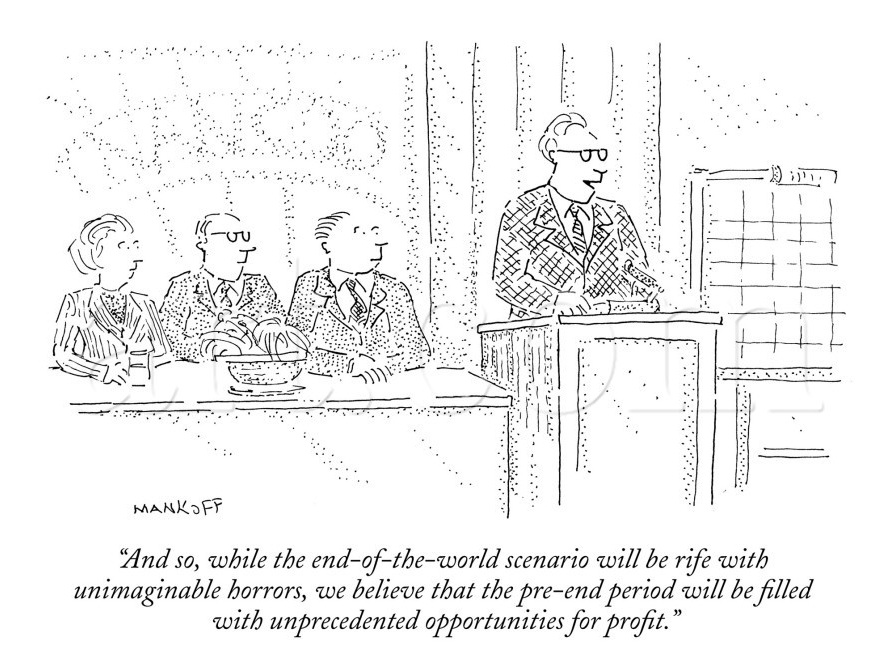
For those who are fans of cartoons from The New Yorker magazine and consistent readers of this blog, you might be able to guess my two favorite cartoons. In the first one, a man in a coat and tie stands at a podium and tells his unseen audience the following: "And so, while the end-of-the-world scenario will be rife with unimaginable horrors, we believe that the pre-end period will be filled with unprecedented opportunities for profit."
In the second, a man in a tattered suit sits cross-legged near a campfire with three children listening to him intently as he says this: "Yes, the planet got destroyed. But for a beautiful moment in time we created a lot of value for shareholders."
Now, in the you-can't-make-this-stuff-up category, financial writer Paul Farrell used the caption from the first cartoon in a 2015 piece for MarketWatch entitled: "Your No. 1 end-of-the-world investing strategy." The subheading is: "How to pick stocks for the near term when long-term trends say collapse is near." The subhead actually seems like it might be another caption from a New Yorker cartoon (or possibly one from The Onion). Why exactly would you invest in stocks—as opposed to seeds of food crops and sturdy garden implements—"when long-term trends say collapse is near"? But I'll put that down to bad headline writing.
Sunday, June 14, 2020
Taking a short break - no post this week
Sunday, June 07, 2020
Insanity? Markets continue disconnect from economy and society
It's hard to ignore the protests on the streets of the world's cities of late. Those protests are coming from a populace who knows that the system they live under long ago stopped benefiting them. While the focus has been the senseless killing by police of an African-American man—all of which was caught on video—there are many other grievances: legalized financial theft by the one percent from the rest of us comes to mind, something that has resulted in growing and egregious inequality across the world.
It's also hard to overestimate the hardship visited on the world's people as many have been deprived of income and daily life by up to three months of pandemic-inspired stay-at-home orders and retail shutdowns. As I mentioned in my previous piece, the U.S. Federal Reserve Bank of Atlanta does a frequently updated estimate of U.S. GDP which as of this writing is minus 53.8 percent for the second quarter. (That's annualized and seasonally adjusted.) The estimate for the current quarter started at minus 12.1 percent and has been dropping like a stone with each new piece of information. For comparison, U.S. GDP during the 2008-2009 financial crises shrank by only 4.2 percent.
And yet, the world's stock markets are behaving as if the protests and the deprivation are inconsequential. After crashing in March in the wake of the spread of the coronavirus pandemic, major stock market indices are at or near all-time highs. For example, the S&P 500 Index was last around its Friday closing price on February 24, before the coronavirus pandemic market panic. How can this be explained?
Sunday, May 31, 2020
Extraordinary popular delusions: Endless bull markets and mining on the moon
Charles Mackay was a 19th century Scottish poet, journalist and author who is best known these days for his book Extraordinary Popular Delusions and the Madness of Crowds. He leads off with three of the most famous financial bubbles in history: the Mississippi Scheme, the South-Sea Bubble and Tulipomania. He also writes of fortune-telling, witches and the Crusades.
Fortune-telling remains a mainstay among the financial elite and the lowliest retail investor on the planet alike. The U.S. Federal Reserve Bank has a sort of running fortune-telling tool called GDPNow that takes up-to-date indicators and plugs them into its formula for projecting the current direction of U.S. GDP. GDPNow is revised every few days as new values for its many components become available.
The latest reading as of May 29 is minus 51.2 percent. That's an annualized number that is seasonally adjusted. It's a number that suggests that economic activity may have fallen at least as much since January as it did in the first four years of the Great Depression (1929 to 1933). At the bottom of the depression in 1933 the U.S. economy had contracted by about 30 percent. Unemployment in the United States reached 25 percent. The Dow Jones Industrial average had lost almost 90 percent of its value.
Sunday, May 24, 2020
A stealth peak in world oil production?
We who have been suggesting that a peak in world oil production was nigh almost from the beginning of this century looked like we might be right when oil prices reached their all-time high in 2008. But since then, we have taken it on the chin for more than a decade as the U.S. shale oil boom kept adding to world supplies—even as production in the rest of the world mostly stagnated or declined.
But then world oil production turned down—not when the recent coronavirus pandemic and associated economic shutdowns hit—but more than a year before while few people were noticing. Monthly fluctuations will make it difficult to pinpoint a peak until long after it occurs. But, let's note the difference between world output in November 2018 which was 84.5 million barrels per day (mbpd) versus December 2019 which was 83.2 mbpd when the world economy was supposedly still in high gear. (These numbers are for crude plus lease condensate which is the definition of oil on major oil exchanges.) Between these two dates monthly oil production was occasionally lower than December 2019, but never higher than November 2018.
Does this mean oil production has reached an all-time peak?
Sunday, May 17, 2020
The world in straight lines: Why we are not ready for discontinuities
It is not unusual to hear someone make definitive statements about the distant future as if they were facts. How often have we heard something like the following: The world economy will double in size by 2050.
When people represent such "facts" in chart form, those facts become somehow more convincing. (You need to click on the charts below to see them clearly):


 |
| SOURCE: OECD |
Sunday, May 10, 2020
Taking a short break - no post this week
Sunday, May 03, 2020
Oil flows spell deep depression
Energy is not just one commodity among many in the economy; it is the commodity. Without energy, nothing gets done. And, oil is not just one form of energy in the energy commodity complex; it is the energy source upon which our modern way of life depends. In fact, it is the main energy source running through the arteries of the global economy.
Far from being a boon to the world, ultra-low oil prices signal that the global economy is flat on its back—even worse, flat on its back with two broken legs.
Petroleum geologist and consultant Art Berman recently detailed the problem in this piece. Berman is the man who accurately predicted—starting way back in 2008—the persistent losses that shale oil and gas would produce for the companies that extracted them. The shale industry continuously vilified Berman for his analysis over the next decade, even as the industry was in the process of blowing 80 percent of investors' capital as of last year. With the arrival of the coronavirus, the coup de grâce has just been delivered to a shale oil and gas industry that was already on its knees.
Perhaps the most important thing to understand about the current oil "glut" is that it is not merely the result of producing too much oil for an economy humming on all cylinders. It is primarily the product of a coronavirus-infested economy in which demand has dropped 20 percent in just a few weeks. As Berman points out, estimated U.S. oil consumption has returned to a level not seen since 1971.